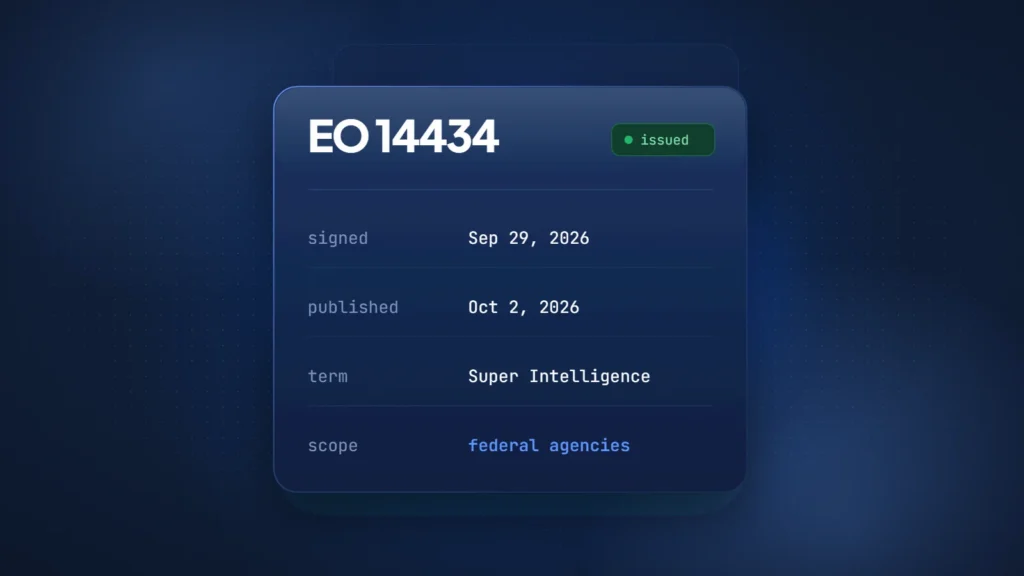
On September 29, 2026, President Trump signed Executive Order 14434, the super intelligence executive order. It directs federal agencies to use “Super Intelligence” and “SI” instead of “Artificial Intelligence” and “AI.” The order changes terminology, not law, and it does not bind private companies.
The text was filed for public inspection on October 1 and published in the Federal Register on October 2, 2026, at 91 FR 63129–63130 (FR Doc. 2026-20321). Federal contractors will likely notice it first, because law firms expect the term in new solicitations.
What the super intelligence executive order says
Executive Order 14434, titled “Inaugurating the Era of Super Intelligence,” swaps one federal vocabulary for another. The technology’s legal meaning does not change.
Section 2(a) holds the operative instruction. Agencies “shall use ‘Super Intelligence’ and ‘SI’ in place of ‘Artificial Intelligence’ and ‘AI’” in their own documents. It covers official correspondence, public communications, websites, reports, policy documents and other non-statutory documents within the executive branch.
Section 1 goes further. It says the executive branch “will not acknowledge the usage of ‘Artificial Intelligence’ and ‘AI’ in any applicable setting” (Sec. 1). As its rationale, the order says today’s systems “do much more than imitate or automate discrete aspects of human intelligence” (Sec. 1).
The qualifier “to the maximum extent permitted by law” appears in both Section 1 and Section 2(a). In our reading, which no court or agency has confirmed, that qualifier leaves room for terms that statutes require.
Section 3(a) defines the new terms by pointing back to the old one. “Super Intelligence” and “SI” mean “the technologies and systems encompassed by the term ‘artificial intelligence’ as defined in section 9401(3) of title 15, United States Code” (Sec. 3(a)). That holds until a later Presidential action or an Act of Congress supersedes it.
Our guide to what SI stands for covers the abbreviation’s other meanings, and our explainer on what superintelligence is covers the older research sense of the word.
Section 4 sets the usual limits. The order must be carried out under applicable law and only as funds allow. It does not “create any right or benefit, substantive or procedural, enforceable at law or in equity by any party” (Sec. 4).
The text is available as a Federal Register PDF on govinfo. The White House also posted the presidential action and a fact sheet, which adds policy context but no new requirements.
What changes and what does not
The order changes the words federal agencies use in new documents. It does not change statutes, earlier regulations, contracts or grants, and its text contains no provision for private companies.
Only Congress can amend statutes, so they sit outside the order. That is why Section 3(b) asks for draft legislative language. Section 2(b) adds: “Nothing in this section requires the alteration of previously issued regulations, Presidential actions, contracts, grants, or other historical documents.”
| Item | Covered by EO 14434? | Where in the order |
|---|---|---|
| Agency correspondence, public communications and websites | Yes, use SI | Sec. 2(a) |
| Reports, policy documents and other non-statutory documents | Yes, use SI | Sec. 2(a) |
| Statutes, including 15 U.S.C. 9401(3) | No, only Congress can amend them | Sec. 3(b) asks for draft language |
| Earlier regulations, Presidential actions, contracts, grants and historical documents | No alteration required | Sec. 2(b) |
| Private companies | Not covered, no provision in the text | None |
| Enforceable rights for any party | None created | Sec. 4 |
For businesses, the effect is indirect. Companies “should expect ‘Super Intelligence’ and ‘SI’ to begin appearing in new solicitations,” K&L Gates wrote on October 2. The firm added that “the definition may evolve,” and Wiley expects increasing use of SI in agency communications and procurement-related materials.
Timeline: from a Truth Social poll to the Federal Register
Executive Order 14434 moved from a public Truth Social poll on September 19, 2026 to publication in the Federal Register on October 2, 2026, a span of 13 days. It was signed on September 29, and California answered with its own order on September 30. The next fixed date is November 28, 2026, when a proposed statutory definition of SI is due.
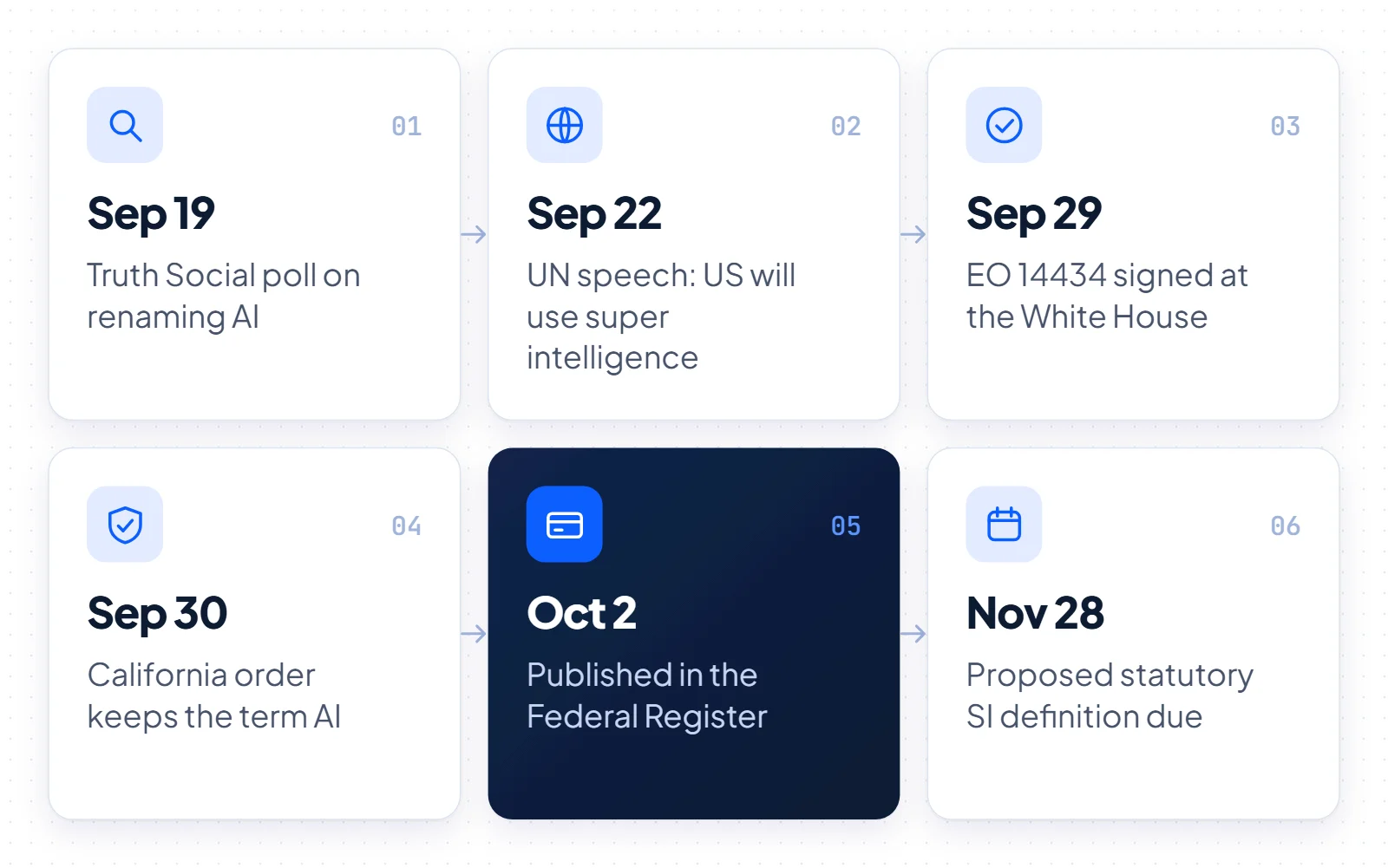
| Date (2026) | Event | Source |
|---|---|---|
| September 19 | Truth Social poll proposes Superior, Extreme or Supreme Intelligence | Gizmodo |
| September 21 | Second poll: Super Intelligence vs Superior Intelligence | Gizmodo |
| September 22 | UN General Assembly speech previews the new term | Deseret News; Reuters |
| September 23 | AP reports a State Department bureau email switching terms | AP |
| September 29 | EO 14434 signed, with EO 14432 (America.gov) and the White House Accord on Super Intelligence | Federal Register; Nextgov/FCW |
| September 30 | California EO N-10-26 keeps “AI” for state agencies | State of California |
| October 2 | Published at 91 FR 63129–63130 | Federal Register |
| November 28 | Proposed legislative definition of SI due | EO 14434, Sec. 3(b) |
As Gizmodo reported on September 21, “Superior Intelligence” won the first poll with 41.5% of the vote, and “Super Intelligence” beat it in a second poll. At the UN on September 22, Trump said the government would use the term super intelligence (Reuters).
The State Department moved before the order existed. An AP report published September 23 said Michael Drager, a deputy assistant secretary in the Bureau of International Organization Affairs, emailed staff after the speech. He asked them to “change all references of ‘Artificial Intelligence’ to ‘Super Intelligence’ in our documents and positions,” per AP. The email, sent September 22, went to one bureau, and AP said it was not clear whether other State Department bureaus would follow.
Three documents were signed on September 29: EO 14434, the America.gov order (EO 14432) and the voluntary White House Accord on Super Intelligence. Nextgov/FCW described the accord as a pledge with “four layers of controls and audits,” separate from the executive order.
Deadlines to watch
EO 14434 contains one deadline: November 28, 2026, 60 days after signing. By then, the Assistant to the President for Science and Technology must send the President proposed legislative language for a federal definition of SI. Freshfields also put the deadline at November 28 in an October 1 note.
Section 3(b) lists three required parts:
- An assessment of whether SI should “modify, expand upon, or otherwise supersede the existing statutory definition of ‘artificial intelligence’”
- Proposed “conforming amendments” to existing statutory references
- Recommendations for further executive action
The proposal goes to the President, and the order does not require its publication. The November 28 date may therefore pass without a public document.
A second date in coverage belongs to a different order. EO 14432, the America.gov order, gives the OMB Director 90 days to issue a memorandum, a deadline of December 28, 2026. EO 14434 mentions OMB only to confirm that the Director’s existing functions are not impaired.
Reactions from industry, critics and California
Some tech leaders welcomed the push, while analysts, researchers and California pushed back.
- Donald Trump, at the UN General Assembly on September 22: “Whoever wins SI, whoever wins superintelligence, wins” (Fox Business).
- Jensen Huang, Nvidia CEO, in an X post reported by SF Standard on October 1: superintelligence “offers an extraordinary opportunity to advance discovery, productivity, security, health, and prosperity.”
- Adam Kovacevich, CEO of Chamber of Progress, told Politico, as reported by The Independent on October 2: “It is a way for the CEOs to signal fealty to the president.”
- David Krueger, AI professor and founder of Evitable, on October 1 (SF Standard): “Superintelligence is already a word… Trump’s word games are adding confusion to this critical… conversation.”
- Jean-Pierre Dubé, marketing professor at the University of Chicago, on September 30 (Newsweek): “[I]t seems unlikely the re-branding will take off unless tech leaders adopt the term.”
- Gavin Newsom, Governor of California, on September 30: “Super intelligence is clearly not coming from the White House.”
California answered with a formal order, Executive Order N-10-26, signed September 30. Where consistent with the law, it binds state agencies under the governor’s authority. They “shall refer to Artificial Intelligence and AI as ‘Artificial Intelligence’ and ‘AI,’ notwithstanding any rebranded or different terminology used by the federal government.”
Law firms read the federal order narrowly. Existing statutes, regulations, contracts, grants and other previously issued documents “will remain unchanged unless modified through future Executive or agency action or public law,” Wiley’s October 2 alert concluded.
Who uses SI and who still says AI
As of October 5, 2026, SI is required inside the US federal executive branch and optional everywhere else. Nvidia CEO Jensen Huang has used the term in posts and remarks, and Elon Musk has said SpaceXAI will become SpaceXSI, without giving a date. Leaders of OpenAI, Anthropic and Google did not use SI at the September 29 event, and Dario Amodei and Greg Brockman said AI. California state agencies keep AI.
| Organization | Uses SI? | Evidence | Date |
|---|---|---|---|
| US federal executive branch | Yes, required | EO 14434, Sec. 2(a) | September 29, 2026 |
| State Department, Bureau of International Organization Affairs | Yes | Email from Deputy Assistant Secretary Michael Drager (AP) | Reported September 23, 2026 |
| California state agencies | No, keep AI | EO N-10-26 | September 30, 2026 |
| SpaceXAI (Elon Musk) | Announced, not yet in use | Musk on X about renaming SpaceXAI to SpaceXSI: “Yes, we will make that change”; no date given and no website change at publication (Euronews) | October 4–5, 2026 |
| Nvidia | Partly, in the CEO’s posts and remarks | Jensen Huang’s X post (SF Standard) and his remark in Washington, “I mean SI. I’m going to get good at this” (The National) | September 29 to October 1, 2026 |
| Meta | Ambiguous | Spokesperson Francis Brennan told Gizmodo that Zuckerberg has been using “superintelligence” publicly for some time; Gizmodo counted “AI” 44 times in his letter | September 29, 2026 |
| OpenAI, Anthropic, Google | No; their leaders did not use “SI” at the September 29 event, and Amodei and Brockman said “AI” | SF Standard | Reported October 1, 2026 |
| Apple | Not reported; no Apple executive attended the September 29 event | SF Standard | Reported October 1, 2026 |
Should your company say SI or AI?
For most private companies, the order requires nothing. Use SI where a federal buyer’s documents use it, and keep AI where customers, international readers and search engines expect it.
Search data supports keeping AI in public copy. On October 5, 2026, Ahrefs showed about 12,000 US monthly searches for “trump ai executive order” and 2,300 for “ai executive order” (12-month averages, mostly reflecting earlier AI orders). The exact phrase “super intelligence executive order” had no measured volume yet. People looking for this order still type AI.
| Situation | Suggested term | Reason |
|---|---|---|
| Federal bids, RFP responses and agency correspondence | Mirror the solicitation; SI where the agency uses it | Wiley and K&L Gates expect SI in new solicitations |
| Existing federal contracts and grants | Keep the contract’s wording | Sec. 2(b) requires no alteration |
| Website, marketing and product copy | AI | US searchers still type AI (Ahrefs, October 5, 2026) |
| EU and other international audiences | AI | EO 14434 binds only US federal agencies; the EU AI Act (Regulation (EU) 2024/1689) uses “artificial intelligence” |
| Work with California state agencies | AI | EO N-10-26 keeps the term |
| Research or safety writing about beyond-human systems | Superintelligence, with a definition | Researchers such as David Krueger say the federal label adds confusion |
Define the term on first use and keep one term per document. In federal work, Wiley’s October 2 alert also advised contractors to “seek clarification as needed to confirm that requirements remain the same.” Both terms now carry associations for some readers, so pick the one your audience already uses.
What the order means for .si domain names
EO 14434 does not mention .si, Slovenia or domain names. .si is Slovenia’s country-code domain. For AI companies it reads as SuperIntelligence. That reading is our framing, not an official meaning, and buysidomains.si sells .si names, so we have an interest.
If you are weighing a name, read our guide to the .si domain for the 2026 registration jump and what to check before buying. Our piece on superintelligence domains compares lab names with .si names.