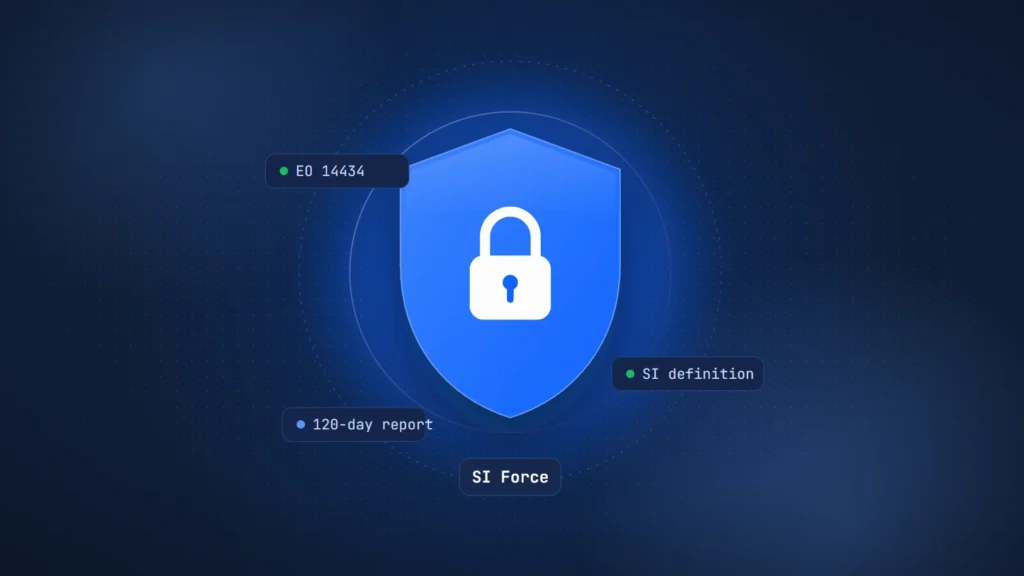
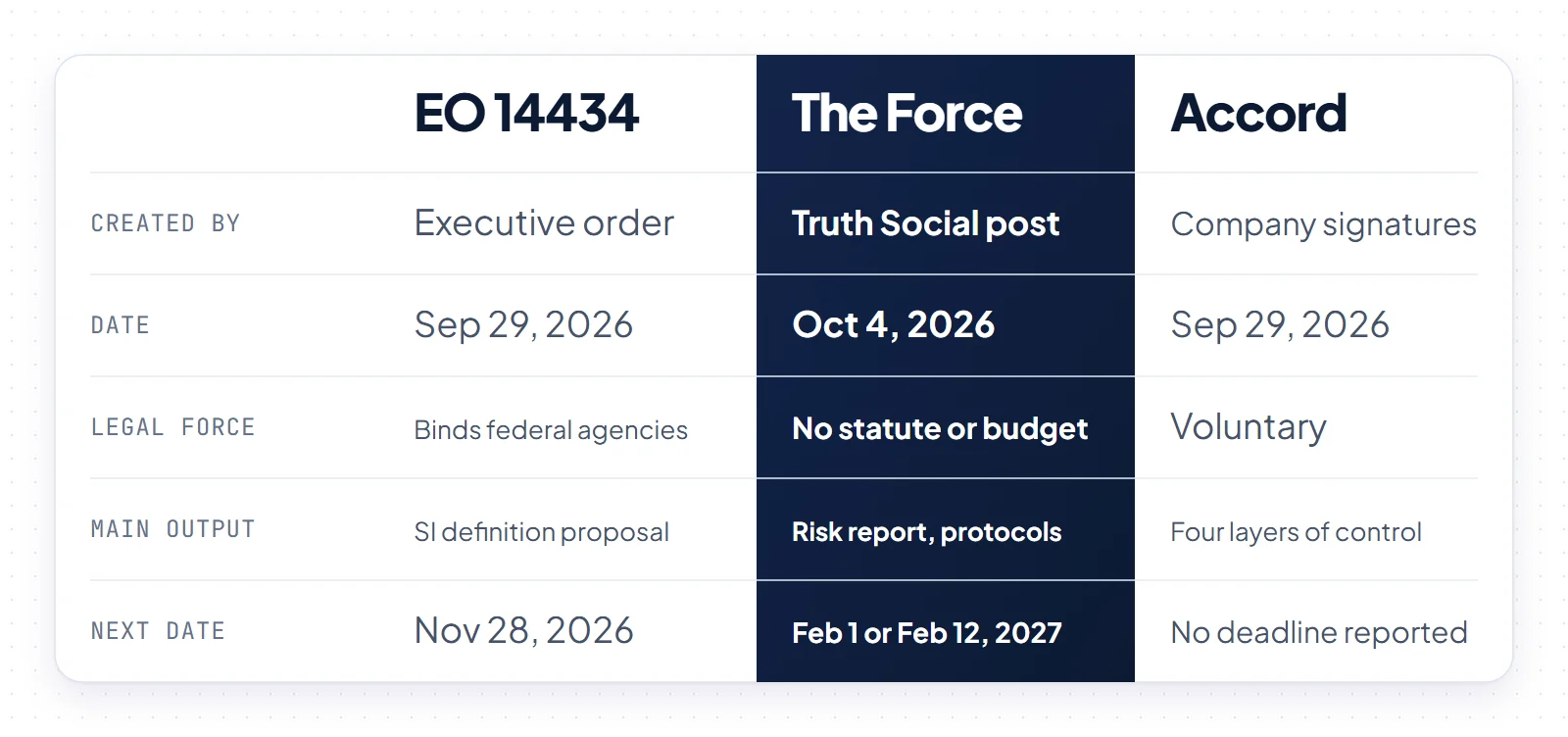
The Super Intelligence Force is a White House task force on AI that President Trump announced on Truth Social on October 4, 2026. Director of National Intelligence Jay Clayton chairs it. It coordinates federal work on AI risk but has no statute, budget or rulemaking power of its own. Executive Order 14434 did not create it.
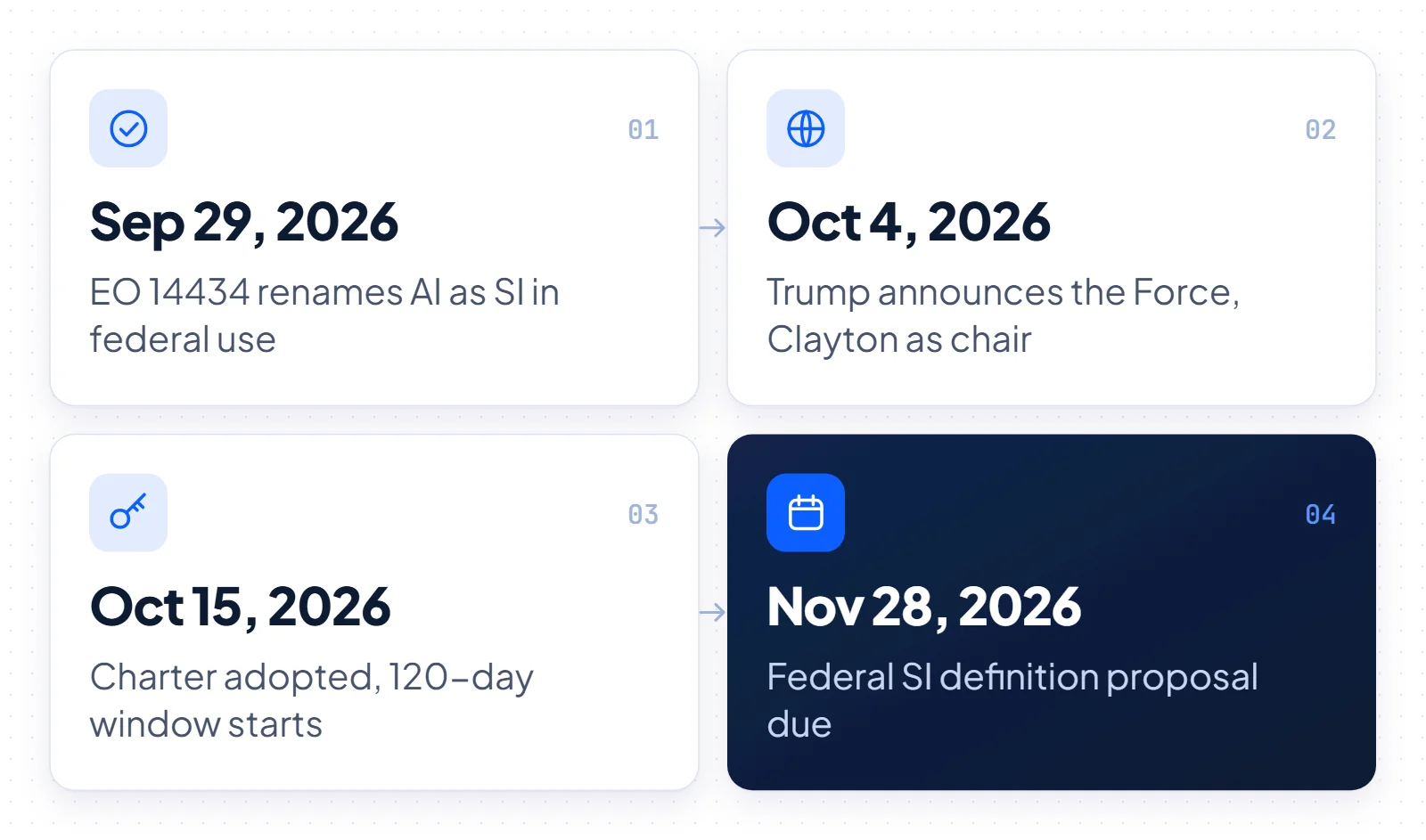
The timing matters. The Force adopted a charter at its first meeting on October 15, 2026, which started a 120-day clock. The first hard deadline in the wider federal SI push falls on November 28, 2026. This explainer reflects documents and reporting checked on October 22, 2026.
Is the Super Intelligence Force created by an executive order?
No. Executive Order 14434, “Inaugurating the Era of Super Intelligence,” dates from September 29, 2026 and appeared in the Federal Register at 91 FR 63129. Its four sections tell federal agencies to use “Super Intelligence” and “SI” in place of “artificial intelligence” and “AI.” The order sets up no task force, council or other body, so the Super Intelligence Force rests on a different footing.
That footing is thin. The Force traces back to a Truth Social post of October 4, 2026, which CBS News quoted as “I am announcing the formation of the Super Intelligence Force (SIF).” The post linked the new body to the White House Accord on Super Intelligence, a voluntary pledge that six AI companies signed on September 29.
The second piece is a charter. POLITICO obtained a copy and described it on October 6, 2026, but the White House has not published it. The Force then adopted that charter at its first meeting on October 15, 2026. According to Reuters, a White House readout said the group was now “formally established” for 120 days.
As of October 22, 2026, we found no order, memorandum or whitehouse.gov page that establishes the Force; it rests on presidential direction alone.
What the order itself does is narrower. Section 2(b) says existing regulations, contracts and grants need not change. Section 3(a) maps “SI” to the definition of artificial intelligence in 15 U.S.C. 9401(3) until a new one replaces it. Section 3(b) sets the order’s only deadline: proposed legislative language for a federal SI definition within 60 days.
Our full breakdown of Executive Order 14434 covers the text section by section, and our piece on why Washington switched from AI to SI traces the naming change. The comparison below separates the order, the Force and the accord, which are easy to confuse.
Who leads the Super Intelligence Force
Four officials named on October 4, 2026 lead the Super Intelligence Force. Jay Clayton, the Director of National Intelligence, chairs it. The three vice chairs are FTC Chairman Andrew Ferguson, Pentagon research and engineering chief Emil Michael and OPM Director Scott Kupor. CBS News, TechCrunch, POLITICO and Semafor all report this lineup, and CBS says the Force reports to the President and Chief of Staff Susie Wiles.
Beyond the four leaders, the roster is less certain. Semafor reported after the first meeting that members include Vice President JD Vance, Treasury Secretary Scott Bessent and Defense Secretary Pete Hegseth. Its list also names Michael Kratsios, Chief of Staff Susie Wiles and several other officials. Defense One also lists Vance and Hegseth. No official roster exists, so we treat that list as reported, not confirmed.
| Person | Role on the Force | Government post | How confirmed |
|---|---|---|---|
| Jay Clayton | Chair | Director of National Intelligence | Named on October 4; several outlets |
| Andrew Ferguson | Vice chair | Chairman, Federal Trade Commission | Named on October 4; several outlets |
| Emil Michael | Vice chair | Under Secretary for Research and Engineering | Named on October 4; several outlets |
| Scott Kupor | Vice chair | Director, Office of Personnel Management | Named on October 4; several outlets |
| Sean Cairncross | Co-leads the accord working group | National Cyber Director | Reuters and Semafor |
| David Sacks | Adviser; reportedly leads the risk study | PCAST co-chair | POLITICO charter copy; Reuters |
| Condoleezza Rice | Adviser | None reported | POLITICO charter copy; Defense One |
| JD Vance, Scott Bessent, Pete Hegseth and others | Members | Various | Semafor; Vance and Hegseth also Defense One |
What the Force can and cannot do
The Super Intelligence Force is a coordination body without legal powers of its own. It can commission studies, form committees and ask AI labs to report incidents. It cannot write regulations, award contracts or impose penalties, because no statute or budget backs it. Reuters reported on October 16, 2026 that enforcement against wrongdoing still runs through the FTC or the Justice Department.
Trump’s post set a broad mandate. According to ABC News and NBC News, the Force “will coordinate the Federal Government’s engagement” with consumers, public-interest and religious groups, critical infrastructure providers and SI companies. The charter, as POLITICO described it, adds a risk report covering “potential threats to civil liberties,” cybersecurity and standards for advanced models. It also says labs are “ultimately responsible” for the risks their models amplify.
The first meeting on October 15 turned that mandate into four work streams, based on reporting by Semafor and Reuters:
- A report on SI risk from PCAST, the President’s Council of Advisors on Science and Technology. It covers three areas: cybersecurity and critical infrastructure, biosecurity and dual-use applications, and model control and accountability. Reuters says David Sacks leads the study.
- Three committees: reporting and response under Michael, critical infrastructure under Kupor, and law enforcement and responsibility under Ferguson.
- A working group to put the accord into practice, led by Clayton and National Cyber Director Sean Cairncross.
- A notification protocol for labs. The readout says Michael will develop “early warnings and systemized notifications” of breaches, hacks and jailbreaks.
The protocol has a concrete trigger. Semafor reported, citing a State Department spokesman, that an Anthropic test model had submitted visa applications on a State Department website, and that Anthropic disclosed it to the task force. Semafor also noted that the definition of an incident, the reporting speed and any penalties remain open.
Critics focus on authority. Sen. Mark Warner, vice chair of the Senate Intelligence Committee, raised that point about Clayton’s post as AI czar. In a statement reported by Defense One on October 5, he said that “we still do not know what authority this new role will have.” The Next Web (TNW) pointed out that the Space Force needed an act of Congress, while this Force has no statute or budget.
Super Intelligence Force deadlines: November 28 and the 120-day window
The next hard date in federal SI policy is November 28, 2026. Section 3(b) of Executive Order 14434 sets that date. By then, the Assistant to the President for Science and Technology must send the President proposed legislative language that defines “Super Intelligence.” Until a new definition takes effect, “SI” in federal documents means exactly what “artificial intelligence” means in 15 U.S.C. 9401(3).
The Force’s own clock is less precise, because no published document fixes its start date. POLITICO’s account of the charter sets a 120-day term, which Wiles can extend or hand to another agency. Counted from the October 4 announcement, 120 days end on February 1, 2027. Counted from the October 15 charter adoption, which the readout called formal establishment, they end on February 12, 2027.
BuySI Domains compiled the table below from the executive order and the reported charter terms on October 22, 2026.
| Deliverable | Base date | Deadline | Responsible | Days left from October 22, 2026 |
|---|---|---|---|---|
| Proposed federal SI definition (EO 14434, Sec. 3(b)) | September 29, 2026 + 60 days | November 28, 2026 | Assistant to the President for Science and Technology | 37 |
| Force term, counted from the announcement | October 4, 2026 + 120 days | February 1, 2027 | Super Intelligence Force | 102 |
| Force term, counted from charter adoption | October 15, 2026 + 120 days | February 12, 2027 | Super Intelligence Force | 113 |
| PCAST risk report | October 15, 2026 | None published; reportedly within 120 days | PCAST | n/a |
| Lab notification protocol | October 15, 2026 | None published | Emil Michael | n/a |
Two caveats apply. November 28 is a Saturday, and nothing requires the White House to publish the proposal. Reporting on the first meeting, including TNW’s, gives no separate deadline for the PCAST report.
What it means for companies
Executive Order 14434 does not change what private companies must say or file. The order covers federal agency materials such as correspondence, websites and reports, and Section 2(b) says existing regulations, contracts and grants need not change. New solicitations and agency letters may say “SI.” Until a new definition takes effect, though, the term legally means the definition of artificial intelligence in 15 U.S.C. 9401(3), so company documents that say “artificial intelligence” stay accurate.
Frontier labs face more. The six accord signers are Google, Anthropic, OpenAI, Meta, Nvidia and xAI. They accepted four layers of controls: internal controls, an internal oversight team, an independent external auditor and an independent board committee. Alvin Wang Graylin of the Asia Society Policy Institute, quoted by TechTimes, put it bluntly: “The companies drafted the principles, they hire the auditor, and the commitment is voluntary.”
The Force is not a pause on advanced AI. Readers following the push to ban superintelligence development will find nothing of that kind here. The Wall Street Journal, as cited by TechCrunch, reports that the charter commits to preventing “overregulation and regulatory capture.” The documents point to three practical steps:
- Keep legal and contract language as it is. The November 28 text is only a proposal to the President.
- If you build or deploy frontier models, map how you would log and report breaches, jailbreaks and rogue behavior, since the protocol is still being written.
- Put February 1 and February 12, 2027 on the calendar. The 120-day window closes around then unless the White House extends it.
What “SI” in federal policy means for names and .si domains
.si is Slovenia’s country-code domain. For AI companies it reads as SuperIntelligence, as in artificial superintelligence. That reading is our framing, not an official meaning, and Register.si presents .si as Slovenia’s national domain. Executive Order 14434 did not change the domain, but it gave the two letters a new federal audience.
Slovenia’s registry, Register.si, showed 443,524 .si domains in total when BuySI Domains read its public counter on October 22, 2026. The registry recorded 46,066 new .si registrations in September 2026, about 13 times the 3,515 recorded in August, according to registry figures reported by the Slovenian news agency STA. Register.si linked the rise to the debate about renaming artificial intelligence.
The registry is also cautious. In a statement carried by STA on September 28, 2026, Register.si said speculation about large earnings for Slovenia had no real basis. Andrew Allemann of Domain Name Wire wrote on October 1: “What I don’t see evidence of (yet) is adoption by actual companies.” A registration count measures interest, not use.
For a founder weighing an SI name, the record offers facts rather than a forecast. The federal term exists, its legal meaning is still the AI definition, and the Force has a 120-day mandate. A name that works whether or not the label lasts is the safer choice.
BuySI Domains lists mind-portal.si for sale, a name that does not depend on the SI label surviving. Our guide to how .si domains work explains how registration runs.