The DNS standards allow a hyphen in domain name labels, and Google’s John Mueller has said on record that it does not hurt rankings. Hyphenated domain names are common under .de and .fr, less common under .com and .uk, and rare under .ai. The real costs are practical: speech, typing and the unhyphenated twin.
The question came up again in June 2026, when Mueller answered it in public once more. To add numbers to the debate, BuySI Domains counted hyphens in the Tranco top 1 million and ran two registration checks on November 12, 2026.
The rules for a hyphen in domain name labels
A domain name label may contain only letters, digits and the hyphen, which is known as the LDH rule. RFC 1035 says labels “must start with a letter, end with a letter or digit, and have as interior characters only letters, digits, and hyphen”, and must be 63 characters or less. RFC 1123 later relaxed the first character to allow a letter or a digit. A hyphen can therefore sit anywhere in a label except the first and the last position.
Two further limits apply. RFC 5890 reserves labels with two hyphens in the third and fourth characters. Labels that begin with xn-- are the ASCII encoding of internationalized domain names, so that prefix is closed to ordinary names. The underscore is not in the permitted set for hostnames, which rules out my_brand.si.
Registries repeat these rules in their own terms. DENIC’s domain guidelines for .de say a domain “may neither begin nor end with a hyphen, nor may it have a hyphen as both its third and fourth characters.” The table below applies these rules to concrete names.
| Name | Status | Reason |
|---|---|---|
mind-portal.si | Valid | Single hyphen inside the label |
-brand.si | Invalid | Starts with a hyphen |
brand-.si | Invalid | Ends with a hyphen |
ab--cd.si | Invalid | Hyphens in positions 3 and 4 are reserved |
xn--… | Restricted | Allowed only as the encoding of an internationalized name |
my_brand.si | Invalid | Underscore is not a permitted hostname character |
How common hyphenated domain names are
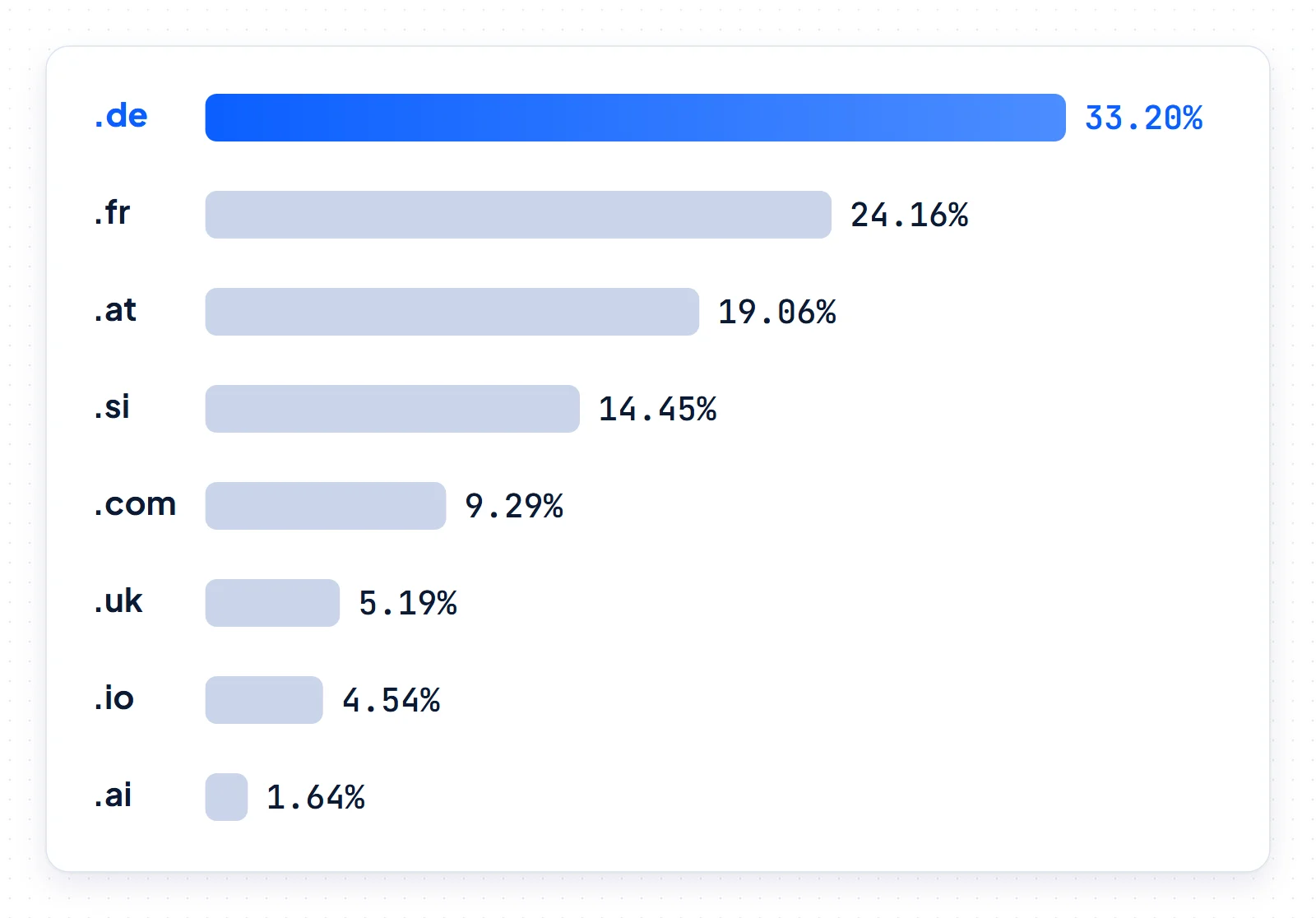
Hyphenated domain names make up 9.44% of the Tranco top 1 million. BuySI Domains counted 94,358 names with at least one hyphen in the registrable label in Tranco list PY2NJ, generated November 11, 2026, excluding xn-- IDN labels. The share varies sharply by TLD: 33.20% under .de, 24.16% under .fr, 9.29% under .com and 1.64% under .ai.
Tranco is a research-oriented ranking of the top 1 million sites, built by researchers at KU Leuven and partners and presented at NDSS 2019. It combines five popularity rankings (Chrome UX Report, Cloudflare Radar, Cisco Umbrella, Majestic and Farsight), averaged over 30 days. We counted on November 12, 2026, and looked only at the registrable label, the part of the name a registrant chooses.
| TLD | Hyphenated names | Names in list | Share (%) |
|---|---|---|---|
| All TLDs | 94,358 | 1,000,000 | 9.44 |
| .de | 10,052 | 30,278 | 33.20 |
| .fr | 2,561 | 10,602 | 24.16 |
| .at | 565 | 2,965 | 19.06 |
| .ch | 532 | 3,645 | 14.60 |
| .si | 115 | 796 | 14.45 |
| .com | 39,368 | 423,885 | 9.29 |
| .uk | 1,595 | 30,728 | 5.19 |
| .io | 478 | 10,523 | 4.54 |
| .ai | 65 | 3,974 | 1.64 |
The split follows language. The TLDs of Germany, Austria and Switzerland (.de, .at and .ch) range from 14.60% to 33.20%, and .fr reaches 24.16%. English-leaning and tech TLDs sit far lower: .uk at 5.19%, .io at 4.54% and .ai at 1.64%. The hyphenated share under .de is about 20 times the share under .ai.
The count has one limitation. Tranco ranks registrable domains of every kind by aggregated popularity, so many of the highest-ranked hyphenated names are infrastructure, such as google-analytics.com and cloudflare-dns.com, not consumer brands. In the top 10,000, 727 names contain a hyphen, a share of 7.27%. Consumer names in that group include t-online.de and merriam-webster.com.
What Google says about hyphens in domain names
Google’s John Mueller has said on record, twice, that hyphens in domain names do not harm rankings. On January 30, 2023, he was asked on Twitter whether hyphens in a domain name cause ranking issues. He replied: “I’m tempted to answer something sarcastic, but no.” In a Bluesky post reported by Search Engine Journal on June 8, 2026, Mueller wrote: “Occasionally we get questions about whether dashes in domain names are ok for SEO (they’re ok).”
Mueller also joked: “HOW MANY DASHES ARE OK? Folks, the answer is apparently 61.” By our arithmetic, 61 fits a 63-character label whose first and last characters cannot be hyphens. A real registry would still refuse such a name, because it puts hyphens in positions 3 and 4. One note on wording: Mueller writes “dashes” where the standards write “hyphen”. Both words name the same character, so a question about a dash in a domain name is a question about the hyphen.
The belief that Google penalizes hyphenated domains is common, but Mueller’s two statements contradict it. Part of the confusion comes from a different piece of advice. Google’s URL structure documentation says: “we recommend using hyphens (-) instead of underscores (_) to separate words in your URLs, as it helps users and search engines better identify concepts in the URL.”
That guidance is about separating words in URLs, and its examples are paths and parameters. It does not mention domain names, so it says nothing for or against a hyphen in the domain itself. On hyphens in domain names and SEO, the answer from Google is short: rankings are not the problem.
Where a hyphen costs you
A hyphen costs you in three places: speech, typing and the unhyphenated twin. Spoken aloud, a hyphenated name needs an extra word, “hyphen” or “dash”, and listeners can drop it. Typed from memory, the joined form is the natural first guess. Both errors lead to the same address: the name without the hyphen.
Most established hyphenated brands also control the unhyphenated twin. BuySI Domains checked 11 well-known brands whose main site is a hyphenated .com, including coca-cola.com, rolls-royce.com, harley-davidson.com, bang-olufsen.com, hapag-lloyd.com, anheuser-busch.com and saint-gobain.com. According to RDAP, the unhyphenated twin was registered in 11 of 11 cases. When BuySI Domains requested the twins over HTTP on November 12, 2026, 7 of the 11 redirected to the hyphenated site. The other 4 twins blocked automated requests, returned an error, did not answer or served a page of their own.
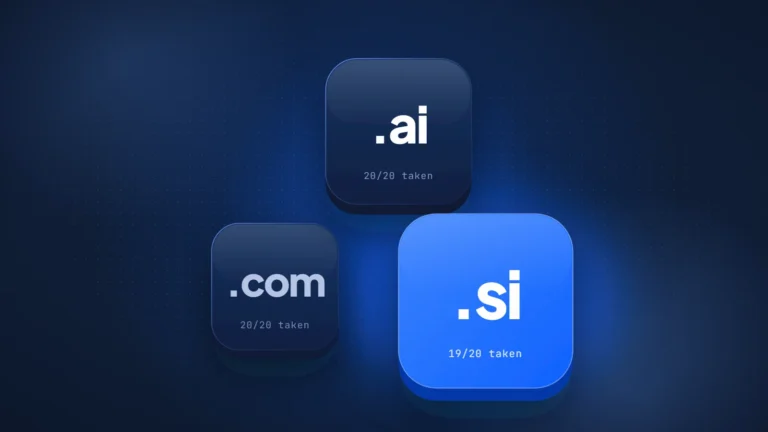
For new names, the joined form is usually gone first. On November 12, 2026, we checked 20 two-word AI-style names, for example “mind portal”, “agent hub”, “prompt lab” and “signal flow”. We looked up each one, joined and hyphenated, in .com, .ai and .si through RDAP.
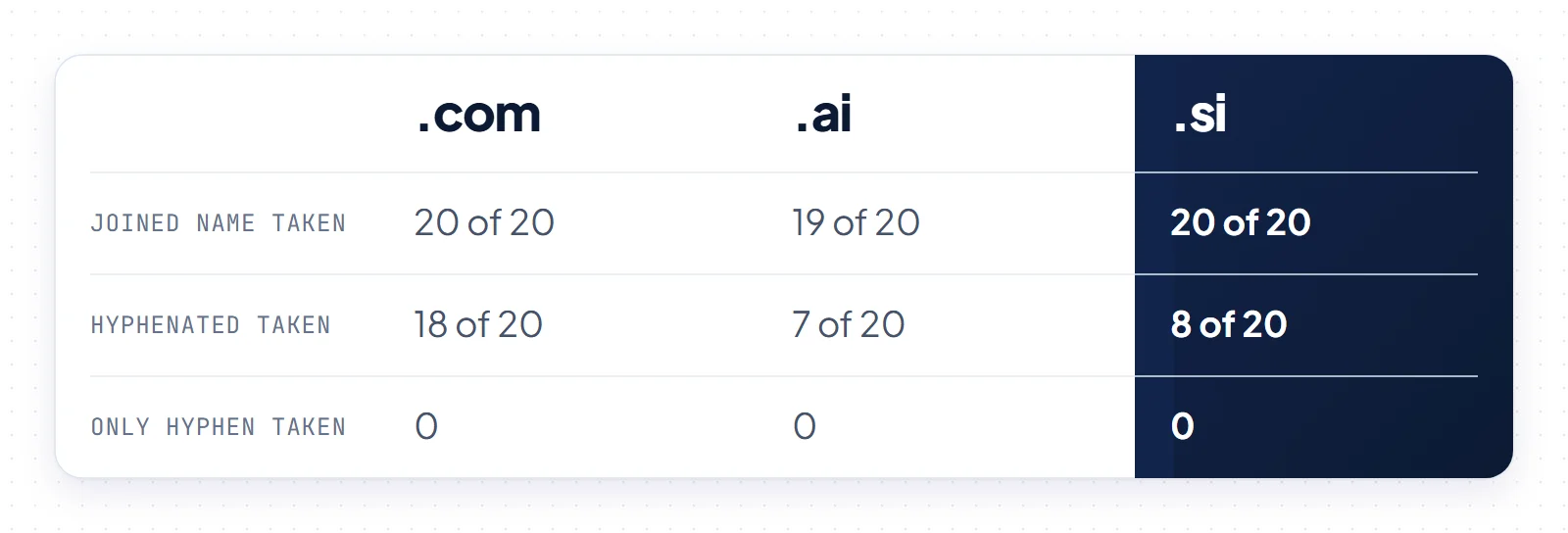
The joined form was registered in 20 of 20 cases in .com, 19 of 20 in .ai and 20 of 20 in .si. The hyphenated form was registered in 18 of 20 cases in .com, 7 of 20 in .ai and 8 of 20 in .si. In no case was the hyphenated form registered while the joined form was free.
The .com dates point the same way. Of the 18 hyphenated .com names, 10 were registered in 2020 or later, and in 17 of those 18 pairs the joined form was registered earlier than its hyphenated version. The pattern fits a fallback: the joined name goes first, and the hyphenated one follows once it is taken. The owner of the hyphenated name then shares its spoken form with someone else’s site.
Security research points to a further risk. A 2017 ACM CCS study by Kintis and colleagues, Hiding in Plain Sight: A Longitudinal Study of Combosquatting Abuse, found 2.7 million combosquatting domains targeting 268 popular US trademarks. The authors describe such domains as “100 times more prevalent than typosquatting domains”. The paper gives no hyphen-specific share. Still, brand-plus-keyword names, sometimes joined with a hyphen as in paypal-members.com, are an established abuse pattern and a close relative of typosquatting, which relies on misspelled names.
Hyphens and .si domains
A .si domain can contain a hyphen. .si is Slovenia’s country-code domain. For AI companies it reads as SuperIntelligence. That reading is informal, and the registration rules are the ordinary ones. Our guide to the .si domain covers the TLD in full.
Register.si’s general terms for registration under .si, valid from November 15, 2024, allow the Latin letters A–Z, the numerals 0–9, the hyphen and letters from the IDN table. Names must be 2 to 63 characters long. The Register.si terms state: “Neither the first nor last character of a Domain name may be a hyphen.” The same terms add: “A Domain name may not contain consecutive hyphens as the third and fourth characters”, with encoded IDN names as the exception.
In usage, .si sits between the German and English patterns. In our Tranco count, 115 of the 796 listed .si names contain a hyphen, a share of 14.45%, close to .ch. In our RDAP check, 8 of the 20 hyphenated AI-style names were registered in .si, against 20 of 20 joined forms. Under .si, too, the joined form is taken far more often than the hyphenated one.
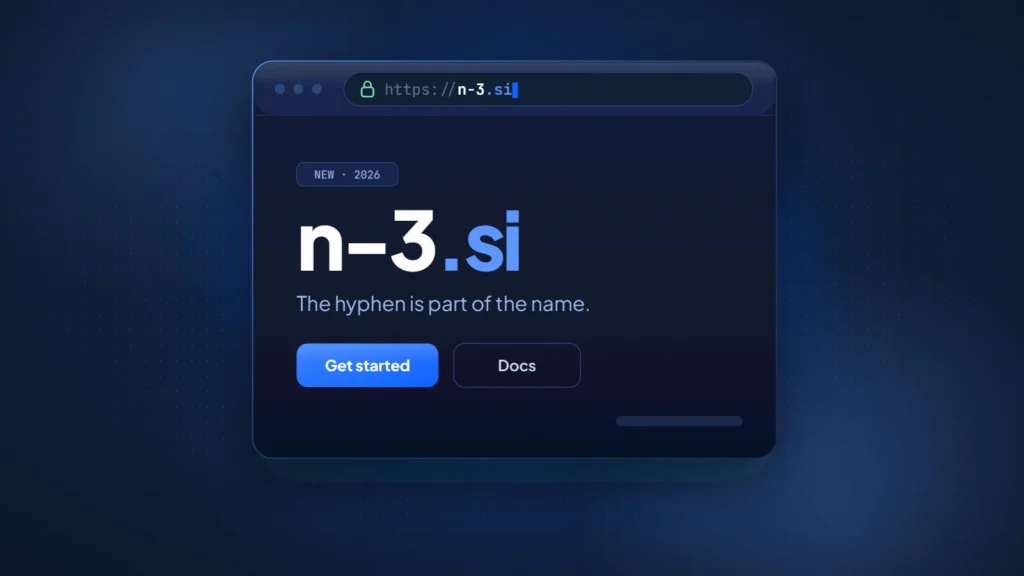
Two names show where a hyphen earns its place. BuySI Domains lists mind-portal.si and n-3.si for sale. mind-portal.si consists of two plain words, and the hyphen marks the word boundary. In n-3.si the hyphen belongs to the term itself: “n-3” is the scientific notation for omega-3 fatty acids, so removing it would change the meaning.
When to use a hyphen, and when to skip it
Use a hyphen when it carries meaning or matches the market, and skip it when it only patches a problem. For the wider process, see our guide on how to choose a domain name.
A hyphen works when:
- The brand itself is hyphenated. Examples are coca-cola.com, mercedes-benz.com, rolls-royce.com, harley-davidson.com, merriam-webster.com and t-online.de, where the primary domain matches the brand as written.
- The market is German or French. With 33.20% of listed .de names and 24.16% of listed .fr names hyphenated, a domain name with a hyphen looks ordinary there.
- Two words misread when joined. A hyphen fixes the word boundary where the joined string suggests a different word or hides a term such as n-3.
Skip the hyphen when:
- You are stacking keywords. A chain of hyphenated keywords is hard to say aloud and hard to remember.
- The joined name is taken. In our check, no hyphenated name existed without its joined twin. A hyphen chosen as a workaround puts your brand next to another owner’s address.
- The audience is English-speaking tech or AI. Only 1.64% of listed .ai names and 4.54% of listed .io names carry a hyphen, so the form looks unusual there.
If you do choose a hyphenated name, register the joined twin as well and redirect it to the main site. In our check the unhyphenated twin of all 11 hyphenated brand domains was already registered, and 7 of those twins redirected to the brand’s site. If the twin is not available, weigh that before you commit, because every spoken mention of the name can send people to an address you do not control.