An exact match domain (EMD) is a domain name whose label repeats a search phrase word for word, such as carinsurance.com for “car insurance.” Google’s 2012 EMD update demoted low-quality sites on exact match names, and Google now says domain keywords alone have hardly any ranking effect. The value of an EMD today comes from branding, recall and type-in traffic.
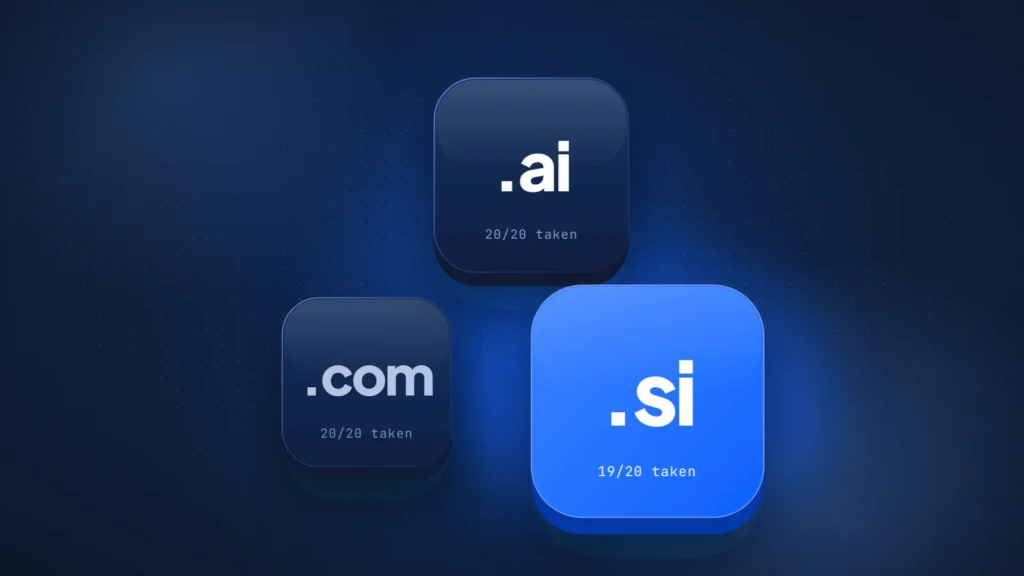
The question matters in late 2026 because descriptive AI names are mostly taken. In a BuySI Domains check on November 18, 2026, all 20 AI keyword phrases we tested already had a holder in both .com and .ai. Google’s position has not moved since 2012. For an AI startup, the bigger issues are trademark strength and having to buy the name from its current holder.
What counts as an exact match domain
An exact match domain is a domain whose second-level label equals a target search phrase with the spaces removed. Examples are machinelearning.com for “machine learning” and aiseo.ai for “AI SEO.” A partial match domain adds at least one word to the phrase, as in aiseotools.com. A brandable domain carries no target keyword at all and earns its meaning through use, the way Stripe or Vercel did.
Two details trip up buyers. Hyphens do not change the category: ai-agents.com still matches the phrase, just in a form that is harder to say aloud. The extension does not change it either, so aiagents.com, aiagents.ai and aiagents.si all match the same phrase exactly.
What the extension does change is how search engines read country signals, which the .si section below covers. If you lean toward names with no keyword in them, our guide to brandable domains and how to choose one covers the alternatives.
What Google’s EMD update changed in 2012
On September 28, 2012, Google’s Matt Cutts announced a “small upcoming Google algo change” that would “reduce low-quality ‘exact-match’ domains in search results.” In a follow-up post, he said the new EMD algorithm affected 0.6% of English-US queries to a noticeable degree. He also said it had no connection to the Panda or Penguin updates, as Search Engine Roundtable reported the next day.
The target was narrow. It aimed at low-quality sites that ranked mainly because their domain matched the query, not at keyword domains as a class. A useful site on a keyword name kept its chances.
Google still applies this check. Its guide to Google Search ranking systems describes an “exact match domain system.” It exists so that Google doesn’t “give too much credit for content hosted under domains designed to exactly match particular queries.” The same guide counts words in a domain name as one of many relevance factors. Google’s SEO Starter Guide, updated December 10, 2025, is more direct. “From a ranking perspective, the keywords in the name of the domain (or URL path) alone have hardly any effect beyond appearing in breadcrumbs,” it states.
John Mueller of Google said the same thing in plainer words. In a Reddit reply covered by Search Engine Journal on February 16, 2022, he wrote: “There’s no secret (or public) SEO-bonus for having your keywords in the domain name.” His advice to site owners was short: “Pick a domain name you can build on for the long run.”
Is there an exact match domain penalty?
Google applies no separate manual penalty to a keyword domain. Google’s guide to ranking systems describes an exact match domain system that keeps names designed to match particular queries from earning too much credit. Separately, Google’s wider systems demote low-quality content on any domain. A keyword domain with thin, spammy pages can drop under those wider systems, while one with a useful site faces no special handicap.
Where an exact match domain can still help
An exact match domain still has real uses, but they sit outside the ranking algorithm. The main ones are recall, instant clarity and type-in visits.
A name like machinelearning.com passes the radio test: someone who hears it once can spell it. A descriptive name also tells a visitor what the site does before the page loads, which helps a small business that prints signs or buys ads. Some owners get direct visits from people who type a phrase plus .com into the address bar, though no public data shows how large that traffic is today.
Inbound links pick up the keyword too. When other sites mention such a brand by name, the anchor text contains the phrase by default. That is a side effect of the name, not a ranking trick. Many blog posts claim keyword domains earn a higher click-through rate, but we found no study we could verify, so treat that as unproven.
Public filings show what some buyers will pay for a strong generic name. MicroStrategy sold the voice.com domain name on May 30, 2019, for $30.0 million in cash. It reported the completed sale in its Form 10-Q for the second quarter of 2019. In 2010, QuinStreet paid $49.7 million in cash for all outstanding shares of CarInsurance.com, Inc. and related entities. That was an acquisition of the company and its website, not a domain-only sale.
Those prices reflect each buyer’s own brand plans. They do not show that keyword domains rise in value over time, and no domain is an investment with a guaranteed return.
The trademark problem with keyword domains
A descriptive name is hard to protect. U.S. trademark law, at 15 U.S.C. §1052(e)(1), refuses registration for a mark that “when used on or in connection with the goods of the applicant is merely descriptive.” Section 1052(f) leaves a door open: a descriptive mark can still register once it has “become distinctive of the applicant’s goods in commerce.” Getting there takes time, sales and evidence.
In USPTO v. Booking.com B.V., decided June 30, 2020, the U.S. Supreme Court ruled 8–1 that a “generic.com” name is not automatically generic. Writing for the majority, Justice Ginsburg held that such a term “is a generic name for a class of goods or services only if the term has that meaning to consumers.” Booking.com won its registration because consumers did not see the name as a label for a whole category of hotel booking sites.
For a startup, an exact match domain on a descriptive phrase starts out as a weak trademark. Rivals stay free to use the same words to describe their own products. A distinctive, coined name avoids the descriptiveness objection from day one. Run the checks in our guide to trademarking an AI company name before you buy any keyword domain.
How many AI keyword domains are in use: our data
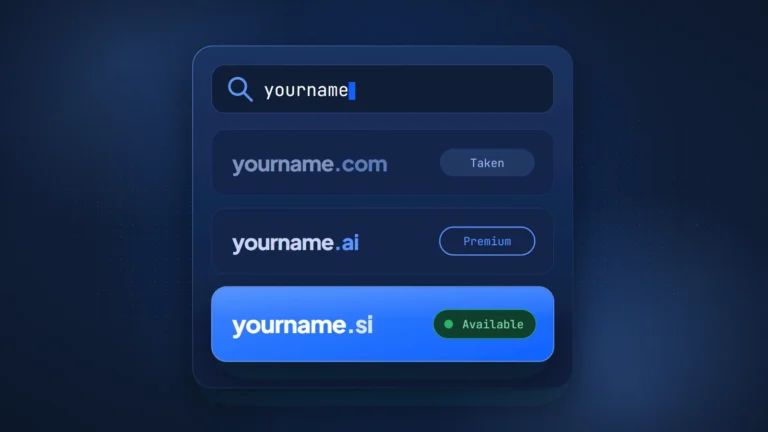
In the BuySI Domains check on November 18, 2026, all 20 AI keyword phrases already had a holder in .com and in .ai. In .si, 19 of 20 were registered too. Of the 40 .com and .ai names, 12 (30%) ran a live site on the same name and 1 redirected to another domain. Another 19 (47.5%) showed a parked, for-sale or placeholder page, and 8 (20%) gave no response or an error. That leaves 28 of 40 (70%) without a live site on the exact name.
The check covered 20 two-word AI and tech phrases as exact match labels, including aiagents, aiseo, generativeai and machinelearning. We ran RDAP lookups for each label in .com, .ai and .si. Then we sent an HTTPS request to every registered .com and .ai name and recorded the final host and page text.
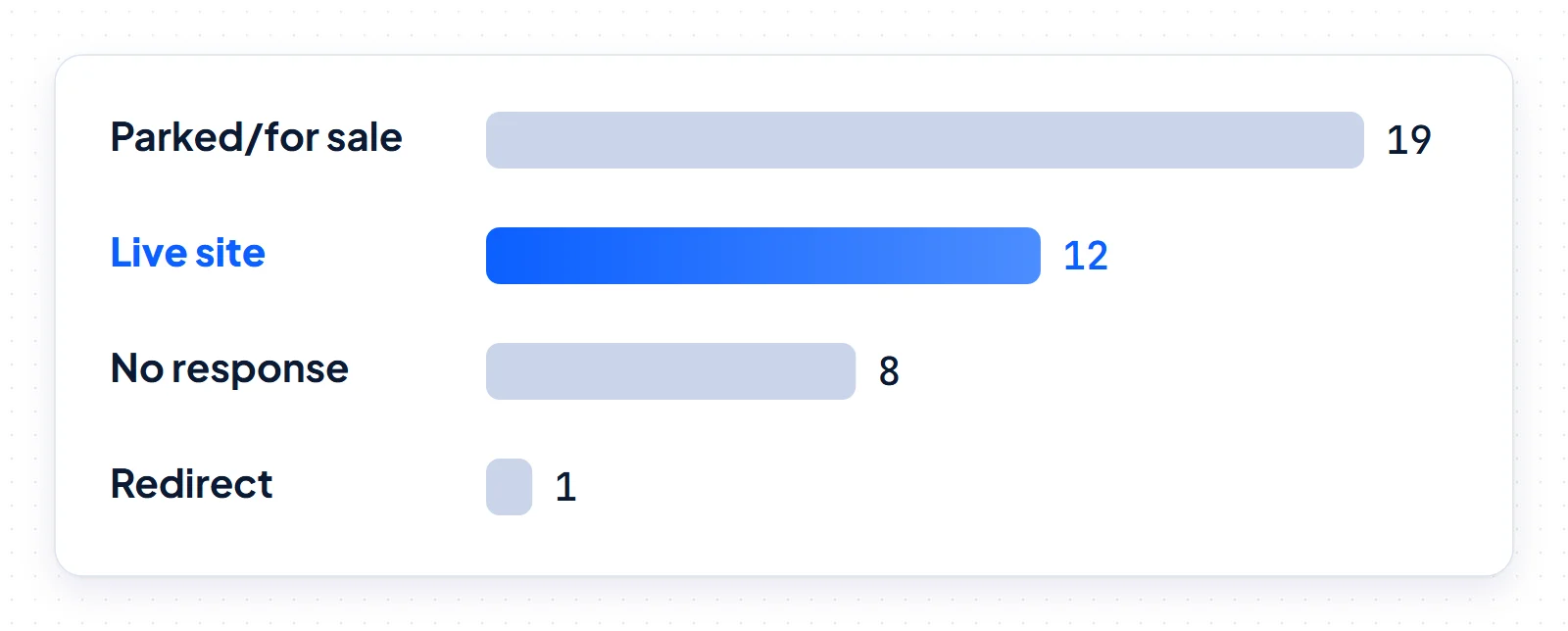
The two extensions split differently. In .com, 6 names ran live sites, 1 redirected to another domain, 7 showed parked or placeholder pages and 6 gave no response. In .ai, 6 ran live sites, 12 of 20 showed parked, for-sale or placeholder pages and 2 gave no response. Most .ai keyword names in this sample had no live product on the exact name.
This is a one-time snapshot from one EU location, and “parked” is an inference from page patterns, so read the counts as a direction rather than a census. For popular AI phrases, the exact match name in .com or .ai already has an owner, and getting it means a negotiation with whoever holds it.
Exact match on a ccTLD: what changes with .si
Putting a keyword on .si changes the extension signal, not the keyword effect. .si is Slovenia’s country-code domain (ccTLD). For AI companies it also reads as SuperIntelligence (see our superintelligence guide), a branding interpretation rather than an official meaning. A keyword plus .si states the category in the label and adds the AI cue in the extension.
Google’s documentation on managing multi-regional and multilingual sites says country-code domains “provide a strong signal to both users and search engines that your site is explicitly intended for a certain country.” Google treats some ccTLDs as generic, and its list, which Google says may change, includes .ai, .io, .co and .me. Slovenia’s .si is not on that list, so Google reads a .si domain as a country signal for Slovenia.
That signal is smaller than it sounds. The SEO Starter Guide says the top-level domain only matters if you target a specific country’s users, “and even then it’s usually a low impact signal.” Content, links and language settings do most of the work. Our guide to ccTLD SEO and ranking a .si domain outside Slovenia covers the setup step by step.
Keyword plus .si fits best where the phrase itself names the product category. A name like aivisibility.si matches the phrase “AI visibility” exactly, the same way humanrobots.si matches “human robots” and netserver.si combines net and server. BuySI Domains lists aivisibility.si for sale, and it also sells humanrobots.si and netserver.si. Under Register.si rules, a .si name runs from 2 to 63 characters and cannot start or end with a hyphen. The General Terms set no residency requirement for holders.
Exact match domain vs partial match vs brandable
The three name types trade instant clarity against trademark strength and room to grow. The table below compares them on the points that still matter after Google’s 2012 change.
| Factor | Exact match domain | Partial match domain | Brandable domain |
|---|---|---|---|
| Example | machinelearning.com | machinelearninghub.com | A coined word, like Vercel |
| What the name contains | The full search phrase, nothing else | The phrase plus at least one extra word | No target keyword |
| Ranking effect of the keyword | Hardly any (Google, 2025) | Hardly any (Google, 2025) | Not applicable |
| Recall and type-in | Strong: the name says what it does | Moderate: one more word to remember | Depends on marketing spend |
| Trademark strength | Weak: often merely descriptive | Weak to moderate | Strongest |
| Availability in .com and .ai | Scarce: 40 of 40 tested names held (BuySI Domains, November 18, 2026) | More open options | Most open options |
| Room to grow | Tied to one category | Tied to one category | Open to new products |
An exact match domain is clear from the first day but hard to protect and tied to one category. A brandable name needs marketing before it means anything, and in return it gives you the strongest trademark and room to add products.
Who should buy an exact match domain, and who should go brandable
Choose an exact match domain when the phrase is the business and will stay the business. A local service, a lead-generation site or a category resource can gain from a name that says exactly what it offers. The trademark weakness matters less when you do not plan to license the brand or expand beyond the category.
Go brandable when you expect the product to change, plan to raise money or need a strong trademark. Most AI startups fit here, because their products often change scope in the first years and a descriptive name can box the company in. Our guide to choosing a domain name has a 9-step checklist for testing candidates before you commit.
A partial match or a keyword on a ccTLD sits in between. In our check, 19 of the 40 exact .com and .ai names showed parked, for-sale or placeholder pages, and 19 of the 20 .si labels were registered too. In any extension, a popular keyword name usually means buying from its current holder. A keyword on .si adds the SuperIntelligence reading to the exact phrase. Whatever you pick, judge it on recall, trademark risk and fit with your plan, not on a ranking boost that Google says domain keywords barely deliver.