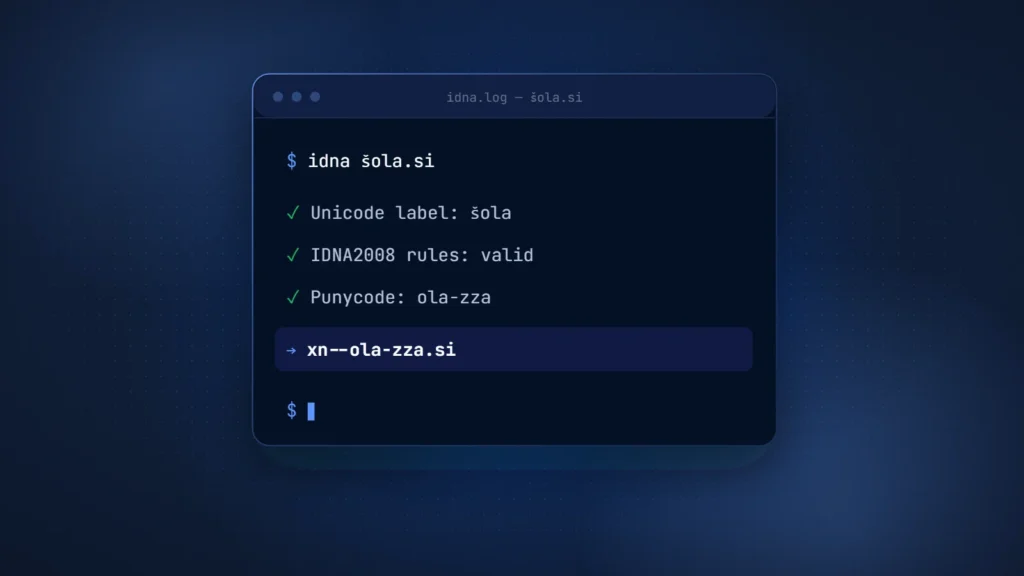
Internationalized domain names (IDNs) are web addresses that contain letters outside the basic a–z set, such as č and ü, or characters from scripts like Cyrillic and Chinese. DNS hostnames are limited to ASCII letters, digits and hyphens, so browsers convert each label with Punycode into an ASCII form that starts with xn--. That is how šola.si travels as xn--ola-zza.si.
As of June 2026, ICANN counts 151 IDN top-level domains in 37 languages and 23 scripts, plus about 4.3 million internationalized domain names registered at the second level. Punycode, the encoding behind them, dates from March 2003, and the current IDNA2008 rules from August 2010.
What are internationalized domain names?
An internationalized domain name has two forms. The U-label is the Unicode spelling people read and type, such as šola. The A-label is the ASCII version stored in DNS, such as xn--ola-zza, and the xn-- prefix sits at the start of every A-label. RFC 5890, published in August 2010, defines both terms.
The IDN can sit at any level of the name: in šola.si only the second-level label is internationalized, while the top-level domain stays ASCII. A fully internationalized name such as пример.рф converts both labels and becomes xn--e1afmkfd.xn--p1ai.
Top-level IDNs arrived years after the first second-level ones. The first IDN country codes, for Egypt, Saudi Arabia and the United Arab Emirates, entered the DNS root on May 5, 2010, and Russia’s .рф (xn--p1ai) followed on May 12, 2010. By our count of IANA’s list dated November 4, 2026, 151 of 1,436 top-level domains start with xn--, a figure that covers IDN gTLDs as well as country-code domains.
How Punycode turns Unicode into xn--
Punycode is the encoding that does the conversion. RFC 3492, written by Adam M. Costello of UC Berkeley and published in March 2003, defines it as a unique and reversible transformation from Unicode to ASCII. Software runs it on each label separately, after a validation step, so the dots between labels never change.
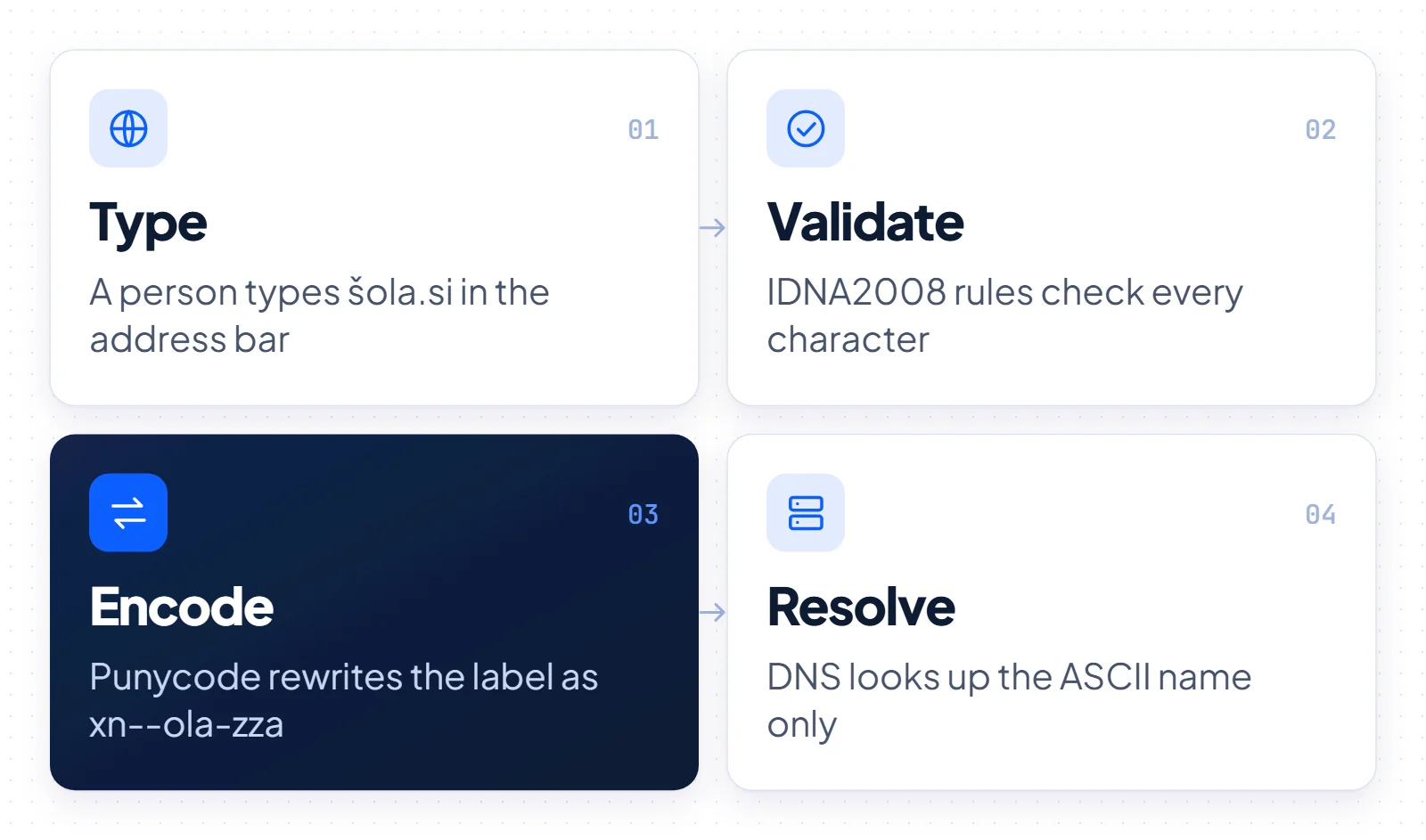
The full path from keyboard to DNS takes four steps:
- Type. A person enters šola.si in the address bar.
- Validate. The browser applies the IDNA2008 rules and the Unicode UTS #46 mapping, which lowercases the label and rejects characters the standard does not permit.
- Encode. Punycode rewrites the label as xn--ola-zza.
- Resolve. DNS looks up xn--ola-zza.si and never sees the Unicode form.
A worked example: šola, bücher and straße
Punycode keeps the plain ASCII letters in their original order, adds a hyphen, then appends a short code. That code records which non-ASCII characters to insert and where. For šola, the letters o, l and a survive as “ola”, and “zza” encodes the š at the front. With the prefix, the result is xn--ola-zza.si.
German works the same way, so bücher.de becomes xn--bcher-kva.de: the letters b, c, h, e and r stay in place, and “kva” stands for the ü.
The German ß shows why the version of the rules matters. The older IDNA2003 standard mapped ß to “ss”, so a browser sent straße.de to strasse.de. Under IDNA2008, straße.de encodes as xn--strae-oqa.de, a name of its own. Unicode’s UTS #46 now calls the old transitional processing deprecated, and all major implementations follow the new behavior.
Punycode limits: length applies to the ASCII form
Length is the main constraint: DNS caps each label at 63 octets (RFC 1035), and the cap applies to the A-label, not to the Unicode spelling. The xn-- prefix and the code add characters, so a long name with several diacritics reaches the limit sooner than its plain spelling suggests. Register.si states that the maximum length of a .si IDN relates to the ACE string, the ASCII-compatible xn-- form.
Minimum length works the other way at Register.si. The registry counts the Unicode form, so č.si is not allowed, even though its ACE string, xn--bea.si, is longer than two characters.
Which characters a registry allows
No global list decides which letters a domain may use. Each registry publishes its own list of permitted characters, often as an IDN table filed with IANA, and it refuses any character outside that list. The table compares registries that matter to European brands.
| TLD | IDNs since | Characters beyond a–z, 0–9 and the hyphen | Rule worth knowing |
|---|---|---|---|
| .si | October 20, 2010 | 92 non-ASCII Latin letters, including č, š and ž (no ß) | Minimum length counts the Unicode form, so č.si is not allowed |
| .de | March 1, 2004 | 93 today: 92 at launch, plus ß from November 16, 2010 | straße.de and strasse.de are two different domains |
| .ch / .li | March 1, 2004 | Listed in Annexes 1 and 2 of the SWITCH General Terms | Minimum 3 characters; ACE string at most 63 characters |
| .com / .net | November 10, 2000 (Verisign testbed) | Set per language; IANA holds 97 IDN tables for .com | Every IDN needs a three-letter language tag |
| .lt | March 30, 2003 | ą, č, ę, ė, į, š, ų, ū, ž | lietuvių.lt does not block lietuviu.lt |
| .ai / .io | Not stated by either registry | No IDN table published at IANA (checked November 5, 2026) | No registry statement on IDNs found |
Verisign runs .com and .net differently from country-code registries. It checks each IDN’s language tag against a list of languages, and where that language has a character table, the whole label must fit inside it. The IANA count of 97 .com tables is our own, made on November 5, 2026.
One rule holds almost everywhere: the accented spelling and the plain spelling are separate domains. Lithuania’s registry DOMREG says lietuvių.lt does not block lietuviu.lt and advises registering both. DENIC says the same about straße.de and strasse.de.
IDNs in .si: č, š, ž and the rest
Slovenia’s .si has accepted IDNs since October 20, 2010, the effective date on the IANA IDN table for .si. By our count, the table lists 129 code points: a–z, 0–9 and the hyphen, plus 92 non-ASCII Latin letters, including č, š and ž but not ß. The same change allowed two-character .si names, where the minimum had been three.
.si is Slovenia’s country-code domain. For AI companies it reads as SuperIntelligence. Our guide to .si domains covers registration in general, so this section stays with the IDN side.
Register.si’s General Terms define an IDN as a domain name with at least one character other than the Latin letters a to z. A Slovenian word such as šola (school) or ključ (key) therefore exists in two .si spellings: the IDN form and the ASCII form without diacritics.
Our check: 40 Slovenian words in both spellings
We took 40 common Slovenian words that contain č, š or ž, such as šola (school), čaj (tea), žoga (ball) and ključ (key). For each word we looked up both .si spellings in Register.si’s RDAP service and in public DNS. In results checked by BuySI Domains on November 5, 2026, the plain ASCII form was taken for 37 of 40 words and the IDN form for 12 of 40. Only 3 of the 40 words were free in both forms. All 12 registered IDN names also had their ASCII twin registered, so no word had only the IDN form taken.
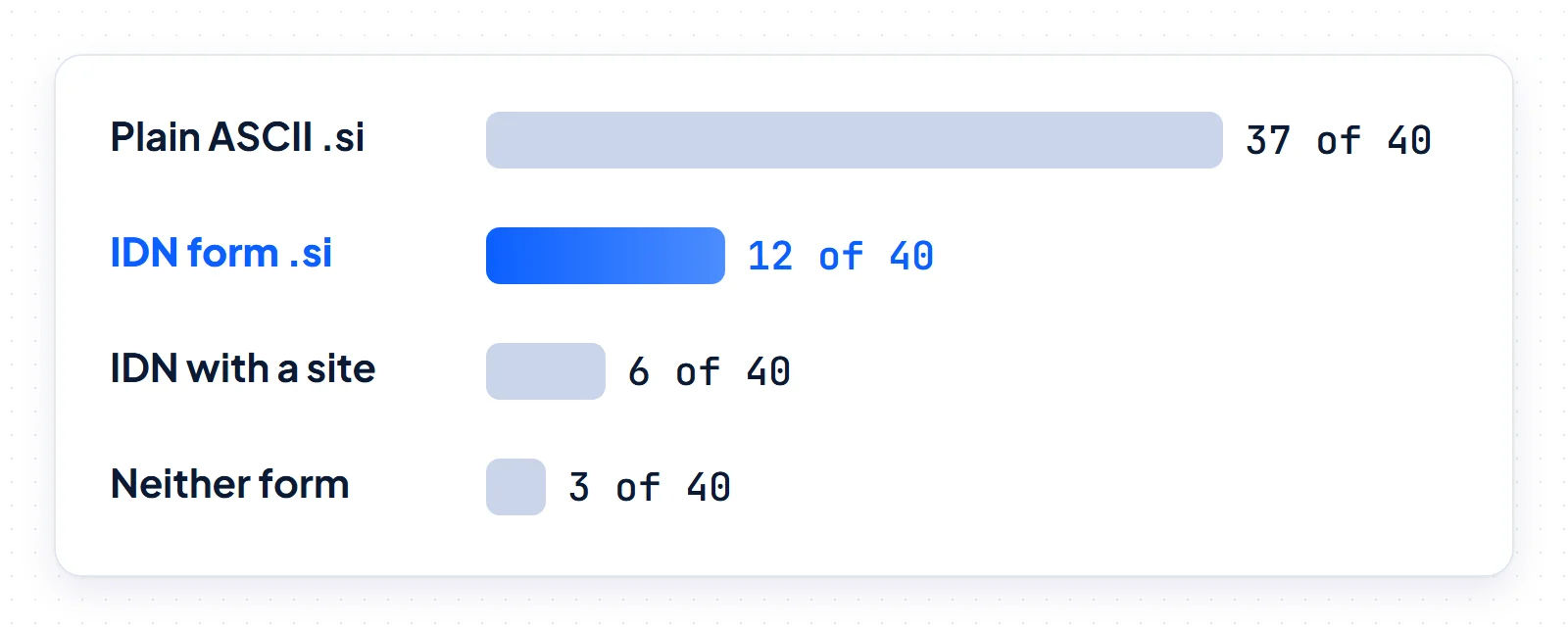
The ASCII twins are mostly older, with 10 of 12 registered between 1996 and 2018. The IDNs cluster at both ends: 4 of 12 date from 2010, the year .si opened to IDNs, and 5 of 12 from January 2025 onward.
Few of these IDNs do much. Of the 12, 10 have nameservers in DNS, 7 have an A record and 6 serve a web page. That leaves 6 of the 40 words with a working IDN site. Of those 6 sites, 5 stay on the IDN itself and 1 redirects to an unrelated .si domain. None redirects to its own ASCII twin.
One limit applies to this check: RDAP for .si shows no registrant, so we cannot tell whether an IDN and its ASCII twin belong to the same holder.
The IDN homograph attack and browser defenses
A homograph attack uses letters from another script that look identical to Latin ones. Gabrilovich and Gontmakher described it in Communications of the ACM in February 2002, after registering a look-alike of microsoft.com with Russian letters. It is the IDN version of typosquatting: the name looks right but leads somewhere else.
The best-known demonstration came on April 14, 2017, when Xudong Zheng published xn--80ak6aa92e.com. The name used only Cyrillic characters and displayed as аррӏе.com. It mixed no scripts, so it passed the browser checks of the time. Zheng had reported it to Chrome and Firefox on January 20, 2017, and the fix shipped in Chrome 58.
Firefox took a different path. Mozilla treated the issue as a problem for domain registrars, so Zheng advised Firefox users to set network.IDN_show_punycode to true, which forces Punycode display. The browser’s display rules date from a 2012 update that applies the Unicode UTS #39 “Moderately Restrictive” profile to TLDs outside its whitelist.
Chrome decides per label whether to show an internationalized domain name in Unicode or as xn--. The Chromium IDN policy, in place since Chrome 51, bars Latin, Cyrillic and Greek letters from mixing in one label. Whole-script look-alikes show as Punycode unless the TLD fits the script. Chrome also shows xn-- for any label whose skeleton matches a top domain such as google.com. A skeleton reduces look-alike characters to one shape, and this rule is why googlé.com appears as xn--.
The same checks can catch a legitimate IDN. A name that resembles a well-known one may show as xn--, so test how your domain displays before you print it anywhere.
Should your brand use an IDN?
For most brands an IDN works best as a second address, not the main one. Browsers and search engines handle IDNs well, while email and everyday typing still cause friction.
Email. Internationalized email has its own standards: RFC 6530 and RFC 6531, published in February 2012, added the SMTPUTF8 extension. An address written with Unicode characters needs that support from every mail server along the route. ICANN’s readiness evaluations look at mail servers in generic top-level domains. They found that the share of domains with mail servers ready for Universal Acceptance rose from about 20% in 2022 to 29% in 2026.
Search. In a July 2015 Search Central post, Google’s John Mueller wrote that Google treats the Punycode hostname as equivalent to the Unicode one. The two forms need no separate redirect or canonical tag for Google. That describes equivalence, not a ranking advantage.
Typing. A customer abroad may have no č or ü on the keyboard. A Slovenian or German visitor types the accented name easily, while a buyer in the US is likely to type the plain spelling. Check too whether your social profiles, app listings and payment forms accept the same spelling.
How to set up an IDN next to your ASCII domain
Register an IDN if your brand name contains a diacritic or if you sell mainly to speakers of that language. It is also worth registering to keep the accented spelling out of other hands. Skip it if your audience is international and your name has no special letters. Our guide to choosing a domain name covers the wider naming decision.
If you do register one, set it up in this order:
- Keep the ASCII domain primary. Use it in print, email signatures and ads, where people type rather than click.
- Point the IDN at it with a 301 redirect. A permanent domain redirect sends visitors and links from the IDN twin to the main site. None of the 12 .si IDNs in our check redirected to its own ASCII twin.
- Cover the xn-- name in your TLS certificate. Certificates list the A-label, so add xn--ola-zza.si rather than šola.si. Without it, the redirect triggers a security warning.
- Test email and forms with both spellings. Send mail to and from the domain, then enter the Unicode and xn-- forms in your sign-up form, CRM and checkout.
- Check how browsers display it. Open the IDN in Chrome, Firefox and Safari and confirm that it shows in Unicode, not as xn--.
A short plain-ASCII name such as mkr.si avoids these questions, because it types the same on every keyboard. BuySI Domains lists mkr.si for sale.