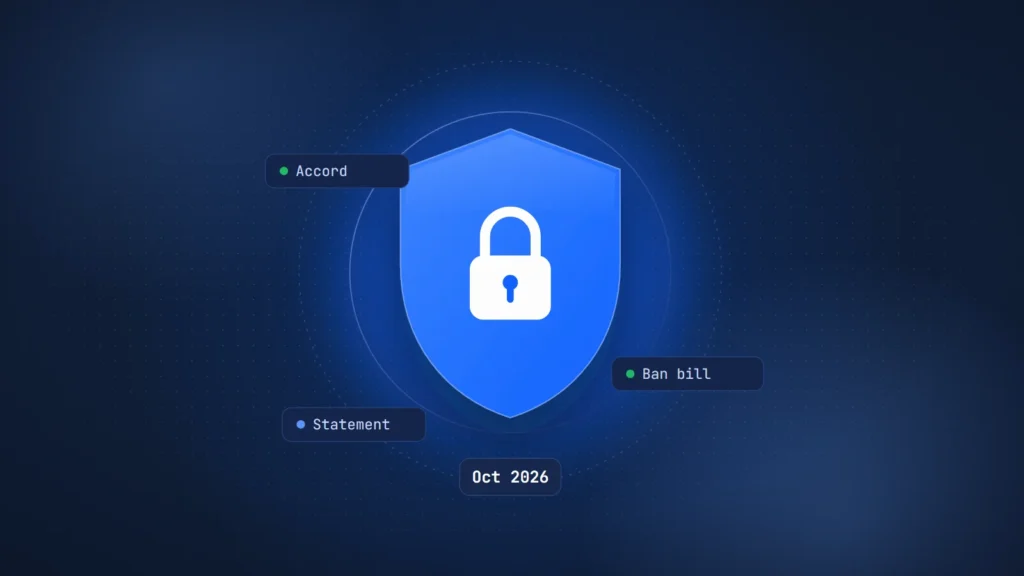
As of October 5, 2026, no superintelligence ban is in force anywhere. US lawmakers introduced a bill to ban it in September 2026. More than 76,000 people have signed the Future of Life Institute’s statement calling for a prohibition on superintelligence until it can be developed safely. The White House instead chose a voluntary accord with six technology companies.
Ahrefs data from October 5, 2026 shows about 150 US and 200 worldwide monthly searches for “superintelligence statement”. “Ban artificial superintelligence act” gets 60 US and 70 worldwide, and the broader “ai regulation” gets 3,200 and 6,500. See our explainer on what superintelligence is.
The superintelligence ban policy map, October 2026
Only two instruments on this map bind companies today: the EU AI Act’s rules for general-purpose AI models and California’s SB 53. Everything else is a petition, a pledge, a bill or a terminology order.
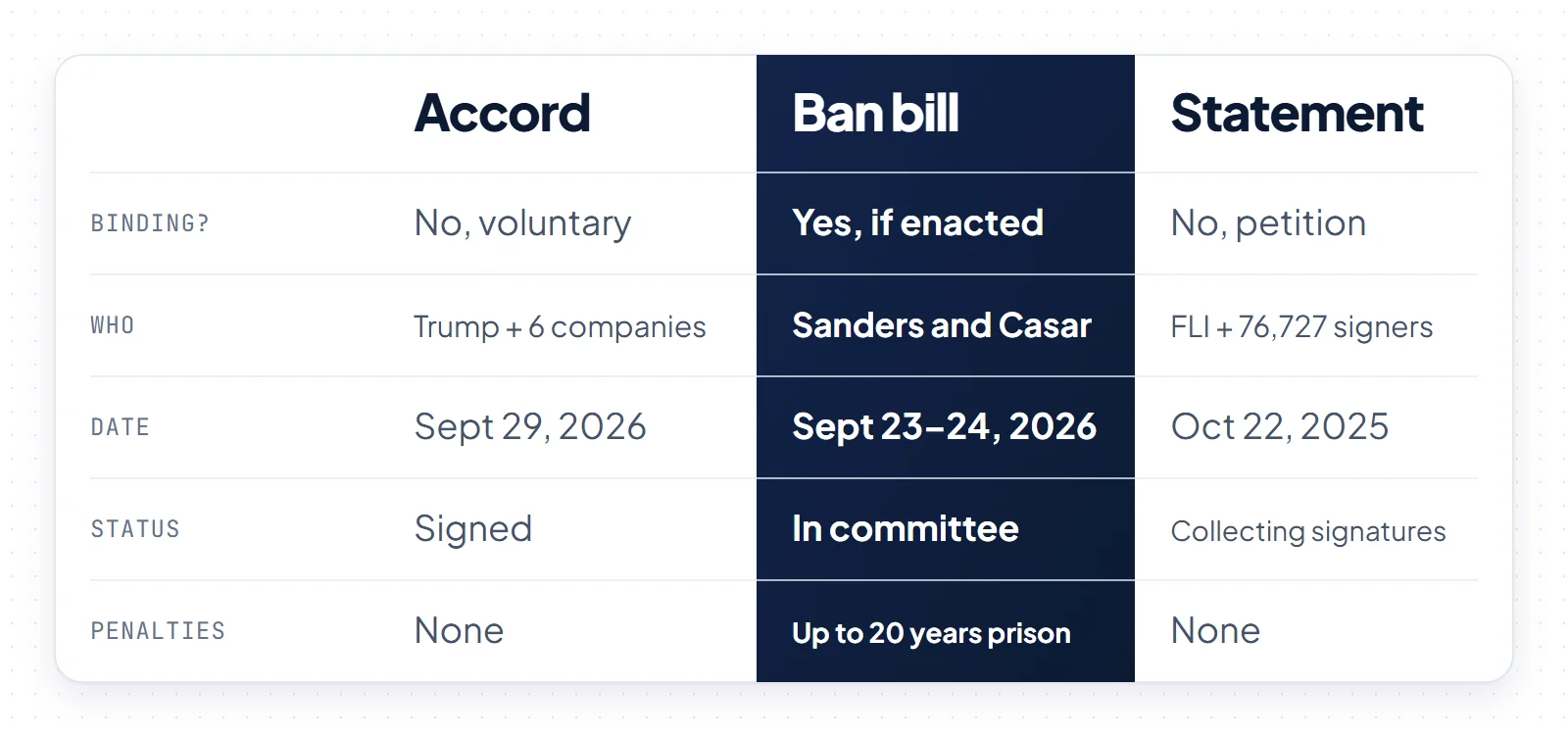
| Instrument | Who | Date | Binding? | Key requirement | Status (Oct 5, 2026) | Source |
|---|---|---|---|---|---|---|
| Statement on Superintelligence | Future of Life Institute | Oct 22, 2025 | No (petition) | Prohibition until scientific consensus on safety and public buy-in | 76,727 signatures | FLI |
| Ban Artificial Superintelligence Act | Sen. Sanders (S. 5493); Rep. Casar (H.R. 10538) | Sept 23–24, 2026 | If enacted | Ban ASI; pause models at 10^25 operations or more | In committee | GovInfo |
| Artificial Superintelligence Bill (UK) | Alex Sobel MP | Sept 8, 2026 | If enacted | Prohibit development, deployment and operation of ASI (long title; text not yet published) | Second reading Nov 13, 2026 | UK Parliament |
| White House Accord on Super Intelligence | Trump and six companies | Sept 29, 2026 | No (voluntary) | Four layers of controls and audits | Signed; no penalties | American Presidency Project |
| Executive Order 14434 | President Trump | Sept 29, 2026 | Federal agencies only | Say “SI” instead of “AI” in non-statutory documents | In force | Federal Register |
| California SB 53 | State of California | Jan 1, 2026 | Yes | Safety framework and incident reports from large frontier developers | In force | California Legislature |
| EU AI Act, GPAI rules | European Union | Aug 2, 2025 | Yes | Documentation, copyright policy, systemic-risk duties | Enforced since Aug 2, 2026 | European Commission |
The case for a ban: the statement and the bill
Supporters of a superintelligence ban argue that no one should build systems smarter than humans until they are proven safe and controllable. Two instruments make that case: an open statement from the Future of Life Institute (FLI) and the Ban Artificial Superintelligence Act.
The Statement on Superintelligence
The Statement on Superintelligence is a single sentence. “We call for a prohibition on the development of superintelligence, not lifted before there is broad scientific consensus that it will be done safely and controllably, and strong public buy-in,” it reads. Fortune reported its launch on October 22, 2025.
FLI’s statement had 76,727 signatures at 18:08 UTC on October 5, 2026, including 5,000 from an Ekō petition. Signatories include Geoffrey Hinton, Yoshua Bengio, Steve Wozniak, Prince Harry and Steve Bannon.
FLI also polled 2,000 US adults from September 29 to October 5, 2025. In FLI’s summary of the results, 64% said superintelligence “should not be developed until there is scientific agreement that it is safe and controllable”. In the same poll, 73% supported strong regulation, and only 5% backed “the current status quo of unregulated development”.
Hinton, a signatory, was also among the experts at Sanders’ closed-door Senate briefing on September 16, 2026. He has repeatedly argued that relying on profit-driven companies to self-regulate AI is a dangerous mistake, Common Dreams reported.
The Ban Artificial Superintelligence Act
Sanders and Casar announced the bill on September 3, 2026, according to press reports and a same-day ITIF statement. Sanders introduced it on September 23 as S. 5493. GovTrack shows it referred to Senate Commerce with no cosponsors. Casar filed H.R. 10538 on September 24 with nine original cosponsors; it went to House Oversight.
The bill text on GovInfo has four main parts:
- Ban: no person may develop, deploy, fund or transfer artificial superintelligence or systems with “superintelligence precursor characteristics” (Sec. 9(a)).
- Pause: systems trained with 10^25 operations or more face a “mandatory pause” until the Secretary of a new Department of Artificial Intelligence finds the department “fully staffed” and its safety rules issued (Sec. 8).
- Shutdown: a system identified as superintelligence must be “immediately rendered inoperative” (Sec. 10).
- Penalties: people in policymaking roles and outside “rogue actors” who recklessly break the pause, ban or charter rules face up to 20 years in prison (Sec. 13(b)). Other employees face a 10-year industry ban (Sec. 13(c)), and companies risk losing their charter, intellectual property and assets (Sec. 13(d)).
On September 23, 2026, Sanders said “we need binding international safety rules, not voluntary standards from the industry” in a joint release with Casar.
The case against a ban
Critics argue that a US ban would give up the lead without stopping other countries. Daniel Castro, president of ITIF, said “America should lead in advanced AI, not ban it” in a September 3, 2026 statement on the announcement. “If the United States stops developing advanced AI, China is unlikely to follow,” he said in comments Fox News published on September 6.
AI scientist Gary Marcus said some parts of the bill were “defensible” but called it “not the right approach,” Fox News reported on September 6. “A permanent, unilateral ban on all research into superhuman AI is too broad,” he said. “If we just pause all development, they will race ahead,” David Sacks, co-chair of PCAST, told CBS News on September 16, 2026, referring to China.
The self-regulation route: the White House Accord
The White House Accord on Super Intelligence, signed on September 29, 2026, asks frontier AI companies to police themselves through four layers of controls and audits. It is voluntary and contains no penalties.
The accord text applies to “every company that is training and deploying frontier models”. It says each company should implement four layers:
- Internal controls “to monitor the capabilities and alignment of its models during training and deployment around areas like cybersecurity, biosecurity, and chemical threats, and to ensure that its models do not hack or access technical systems in unintended ways.”
- An internal team “to ensure all of the controls, monitoring, and detection are operating as intended, and that any issues are remediated.”
- “Partner with an independent external auditor or evaluator to carry out independent assessments of whether the controls, monitoring, and detection are operating as intended.”
- “Designate an independent committee of the board of directors to oversee and receive reports from the teams operating the controls and the internal and external auditors and evaluators, as well as to ensure any issues identified are remediated.”
The accord treats law as a later option: “Over time, it may make sense to codify these steps into laws or regulations,” the text says. It also does not require companies to publish audit results.
Who signed, and how it was received
President Trump signed with Sundar Pichai (Google), Dario Amodei (Anthropic), Mark Zuckerberg (Meta), Greg Brockman (OpenAI), Elon Musk (xAI) and Jensen Huang (Nvidia). Microsoft CEO Satya Nadella attended but did not sign, according to AP. Safe Superintelligence (SSI) did not sign either.
Trump said the accord would be “morally binding,” according to AP via NPR on September 30, 2026. After the September 29 White House summit, House Speaker Mike Johnson called it “a statement of principles” and “commitments that are voluntary on behalf of the industry,” Fox Business reported.
Connor Martin’s October 1, 2026 analysis for the Council on Foreign Relations is headlined “Trump’s AI Safety Pact Is Toothless. But There Is a Path Forward.” Martin argues the accord “does not actually compel the companies to do anything” while leaving open who is liable for violations.
Binding rules that already apply: EU AI Act and SB 53
As of October 5, 2026, two sets of rules bind frontier AI developers: the EU AI Act’s general-purpose AI (GPAI) obligations, applied since August 2, 2025, and California’s SB 53, operative since January 1, 2026. Neither bans superintelligence. Both require transparency and risk management from the largest developers.
EU AI Act: general-purpose AI obligations
Under the European Commission’s GPAI guidance, provider obligations have applied since August 2, 2025. Commission enforcement began on August 2, 2026, and models placed on the market before August 2, 2025 must comply by August 2, 2027. Fines reach 3% of worldwide turnover or €15 million, whichever is higher.
Every GPAI provider needs technical documentation and a copyright policy. The Act presumes that models trained with more than 10^25 FLOP carry systemic risk; they face extra duties.
California SB 53
SB 53, signed on September 29, 2025, became operative on January 1, 2026. SB 53 mainly binds large frontier developers: companies with more than $500 million in revenue that train models with more than 10^26 operations. They must publish a frontier AI framework, report critical safety incidents to the state and protect whistleblowers.
The Attorney General enforces SB 53, with civil penalties of up to $1 million per violation. On September 18, 2026, Governor Gavin Newsom’s Executive Order N-9-26 moved to speed up third-party AI oversight. It also asked for recommendations, including a “kill switch” for frontier models.
Where EO 14434 fits: terminology, not regulation
Executive Order 14434, signed on September 29, 2026, changes vocabulary, not obligations. The order tells federal agencies to use “Super Intelligence” and “SI” instead of “AI” in non-statutory executive-branch documents. Executive Order 14434 does not regulate AI companies.
The Federal Register published the order at 91 FR 63129 on October 2. Under Section 3(a), SI means AI as defined in 15 U.S.C. 9401(3). A proposed statutory definition is due within 60 days, around November 28, 2026. Our guide to what SI stands for explains the term.
California answered on September 30 with Executive Order N-10-26, which keeps “AI” in state usage and likewise sets no duties for developers.
How each instrument defines superintelligence
Of the texts published so far, only the Ban Artificial Superintelligence Act gives superintelligence a legal definition. The accord, SB 53 and the EU AI Act regulate by compute thresholds or frontier status instead.
In full, Sec. 3(2) of the bill defines artificial superintelligence as “an artificial intelligence system that exhibits, or can easily be modified to exhibit, either of the following capabilities: (A) The artificial intelligence system exceeds human cognitive performance and capabilities across most domains or tasks, including those related to decision making, learning, and adaptive behavior. (B) The artificial intelligence system has sufficient capabilities to plan and execute the destruction or disempowerment of humanity, including by overthrowing or undermining the Federal Government”.
| Instrument | Definition or scope | Compute line |
|---|---|---|
| Ban Artificial Superintelligence Act | Beats humans across most domains, or could disempower humanity | 10^25 operations (pause) |
| FLI statement | “Significantly outperform all humans on essentially all cognitive tasks” | None |
| White House Accord | No definition; covers frontier model developers | None |
| EO 14434 | SI means AI under 15 U.S.C. 9401(3) | None |
| California SB 53 | No definition; “catastrophic risk” includes loss of control | Over 10^26 operations |
| EU AI Act | No definition; GPAI models with systemic risk | Over 10^25 FLOP |
The bill and the EU AI Act draw the same compute line at 10^25 operations, with opposite effects. The bill would pause every model above it, while the EU lets such models operate with extra duties. For how ASI differs from AGI, see our comparison of AGI vs ASI.
What founders and AI teams should watch
For most AI startups, compliance work in October 2026 comes from the EU AI Act and SB 53, not the ban proposals or the accord. These dates show where that could change:
- November 13, 2026: second reading of the UK Artificial Superintelligence Bill.
- November 28, 2026: the EO 14434 deadline for a proposed statutory definition of SI.
- No date set: committee action on S. 5493 and H.R. 10538.
- August 2, 2027: the EU deadline for GPAI models placed on the market before August 2, 2025.
Teams that sell general-purpose models in the EU already carry documentation and copyright duties, plus extra obligations for models above 10^25 FLOP. Developers with more than $500 million in revenue that train above 10^26 operations fall under SB 53.
Teams that automate AI research should read the bill’s precursor list. One listed trait is the capacity “to automate or greatly accelerate the process of artificial intelligence research and development”.
The debate has also changed the words founders use. Executive Order 14434 made “SI” the federal term for AI, and the letters match Slovenia’s domain. .si is Slovenia’s country-code domain. For AI companies it reads as SuperIntelligence. Our guide to the .si domain explains who can register one and how.