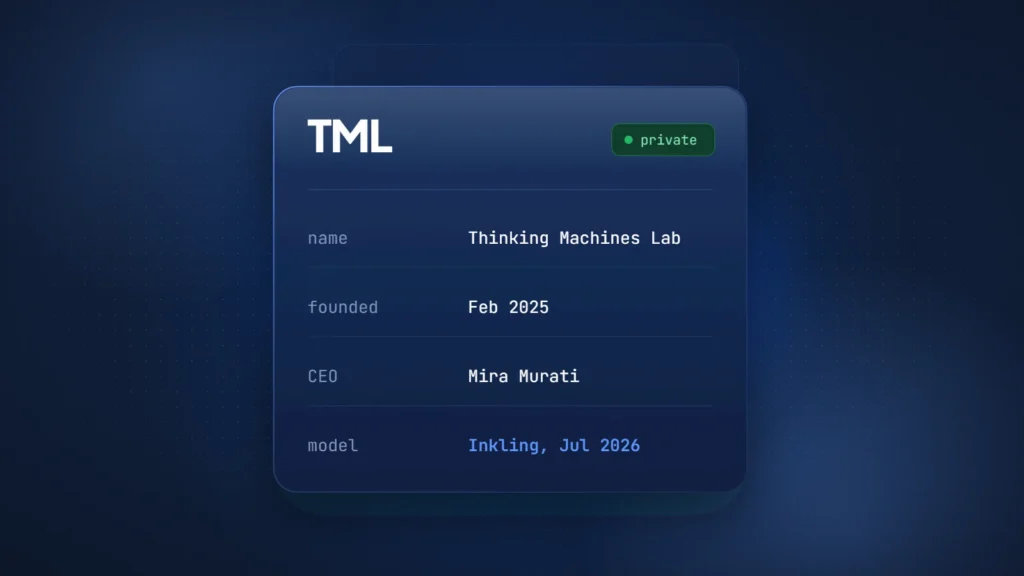
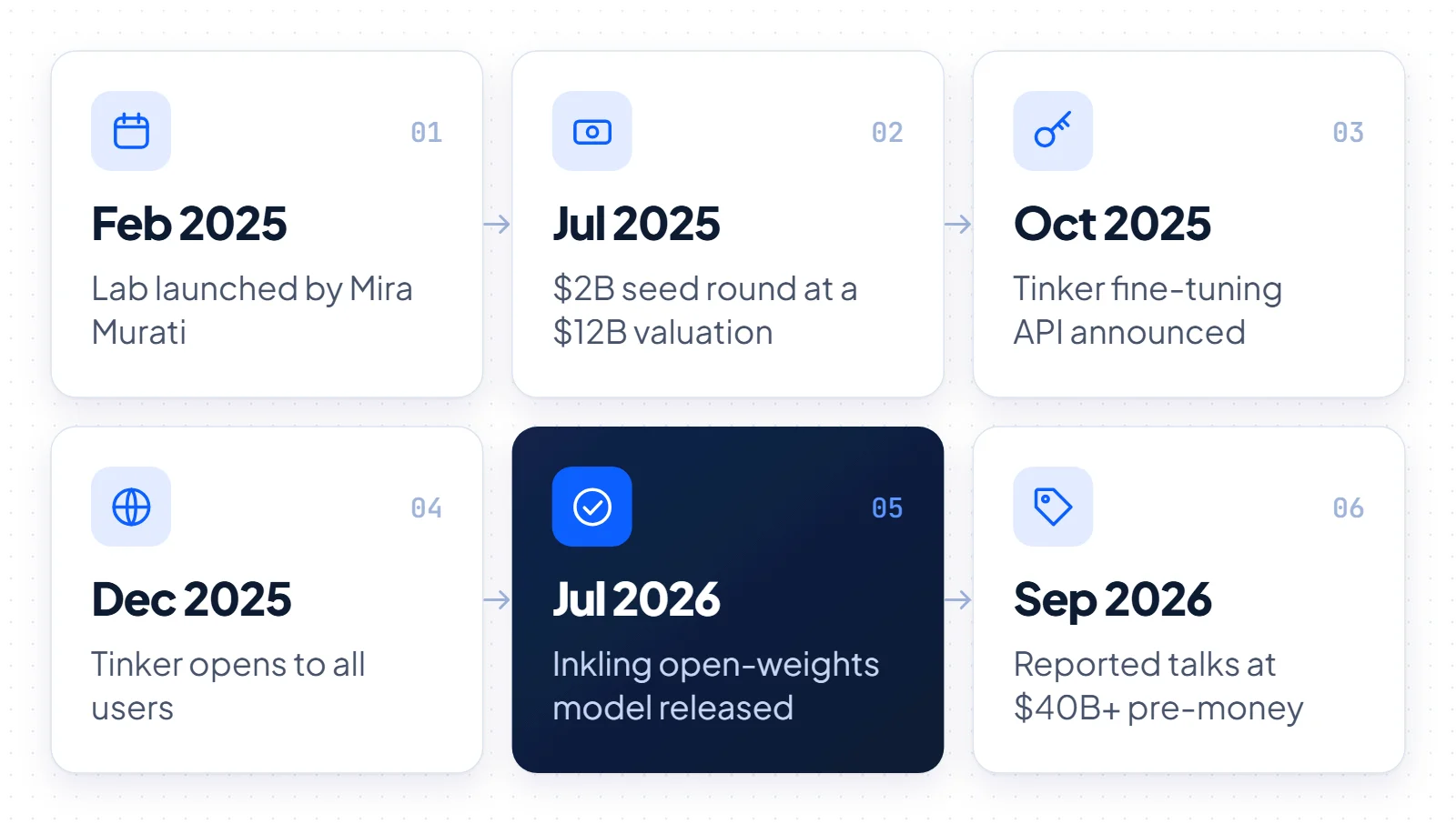
Thinking Machines Lab is the AI company Mira Murati, OpenAI’s former chief technology officer, launched in February 2025. It sells Tinker, a fine-tuning service for open-weights models, and in July 2026 it released Inkling, an open-weights model anyone can download. The company is private, so it has no public shares.
Interest is high for a company that is not yet two years old. In our Ahrefs check on October 5, 2026, “thinking machines lab” drew about 10,000 monthly searches in the US and 21,000 worldwide. The founder’s name, “mira murati”, drew about 31,000 in the US and 107,000 worldwide. This profile separates what the lab has confirmed from what the press has reported.
Thinking Machines Lab at a glance
Thinking Machines Lab is an AI research and product company with two product lines: the Tinker training API and the Inkling model family. The table collects the core facts as of October 5, 2026.
| Item | Detail |
|---|---|
| Founded | February 18, 2025 (public launch) |
| Founders | Mira Murati, John Schulman, Barret Zoph, Lilian Weng, Luke Metz, Andrew Tulloch (six co-founders, per press coverage) |
| CEO | Mira Murati, former CTO of OpenAI |
| CTO | Soumith Chintala, co-founder of PyTorch (since January 14, 2026) |
| Headquarters | San Francisco; first New York office leased in August 2026 (Commercial Observer) |
| Products | Tinker (training API); Inkling and Inkling-Small (open-weights models) |
| Latest models | Inkling (July 15, 2026); Inkling-Small (July 30, 2026) |
| Funding on record | About $2 billion seed at a $12 billion valuation (July 2025); Nvidia investment of undisclosed size (March 2026) |
| Employees | Around 140 (TechCrunch, April 2026) |
| Website | thinkingmachines.ai |
The homepage describes a future where everyone can make AI work “for their unique needs and goals.” The Inkling announcement states the mission directly: “Our mission is to build AI that extends human will and judgment.”
The lab has no link to Thinking Machines Corporation, the company founded in 1983 that built the Connection Machine. Only the name is shared.
What Thinking Machines Lab builds: Tinker and Inkling
Thinking Machines Lab sells one service and publishes two open-weights models. Tinker is a paid training API for fine-tuning open-weights models, and Inkling is the lab’s own model family, released for anyone to download and run.
| Product | Launched | What it does | Key facts |
|---|---|---|---|
| Tinker | October 1, 2025 (open to all December 12, 2025) | Training API: users write the fine-tuning code, the lab runs the distributed infrastructure | Uses LoRA; usage pricing in USD per million tokens; models include Inkling, Qwen, DeepSeek-V3.1 and gpt-oss |
| Inkling | July 15, 2026 | Open-weights mixture-of-experts model | 975B total / 41B active parameters; up to 1M-token context; Apache 2.0 license on Hugging Face |
| Inkling-Small | July 30, 2026 | Smaller open-weights model | 276B total / 12B active parameters; on Hugging Face and Tinker |
Tinker: a training API for researchers
The lab announced Tinker on October 1, 2025, calling it “a flexible API for fine-tuning language models” and opening it as a free private beta with a waitlist. Tinker uses LoRA so that several training runs can share the same pool of compute. On December 12, 2025, the waitlist ended and the service opened to everyone, with vision input added. Pricing is now usage-based, quoted in US dollars per million tokens.
The most detailed public result comes from Bridgewater. In a guest post dated June 30, 2026, researchers from Bridgewater AIA Labs reported that a Qwen3-235B model trained on Tinker reached 84.7% average accuracy on six financial tasks. The best frontier model they tested scored 78.2%, so the Tinker-trained model made 29.8% fewer mistakes at a 13.8x lower inference cost per task.
The authors produced these numbers themselves, so they are a customer case study, not an independent audit.
Inkling: the open-weights model
Inkling arrived on July 15, 2026. It is a mixture-of-experts model with 975 billion total and 41 billion active parameters and a context window of up to 1 million tokens. The lab trained it from scratch on 45 trillion tokens of text, images, audio and video, using a DeepSeek-V3-style architecture. The Hugging Face model card lists the license as Apache 2.0.
The company is modest about the result. Its own post calls Inkling “not the strongest overall model available today, open or closed”, and closed frontier models score higher in its benchmark table. Artificial Analysis scored Inkling 41 on its Intelligence Index, ahead of Nemotron 3 Ultra at 38. That made it the leading open-weights release from a US lab at launch.
A smaller sibling, Inkling-Small, followed on July 30, 2026, with 276 billion total and 12 billion active parameters. Both models are on Hugging Face and inside Tinker.
Research
The lab also publishes research on its Connectionism blog. “Defeating Nondeterminism in LLM Inference” by Horace He and colleagues, from September 10, 2025, traced inconsistent model outputs to a lack of batch invariance. “LoRA Without Regret” by John Schulman and colleagues followed on September 29, 2025.
Thinking Machines Lab funding and valuation
Thinking Machines Lab has one closed, priced round on record: a seed round of about $2 billion at a $12 billion valuation in July 2025. Every later valuation comes from reported talks that the company has not confirmed.
| Date | Round | Amount | Valuation | Investors | Source and status |
|---|---|---|---|---|---|
| July 15, 2025 | Seed | About $2 billion | $12 billion | Led by Andreessen Horowitz; Nvidia, Accel, ServiceNow, Cisco, AMD, Jane Street | TechCrunch; closed |
| November 13, 2025 | Talks | Not disclosed | Roughly $50 billion | Not disclosed | Bloomberg; reported, no close announced |
| March 10, 2026 | Strategic investment | Not disclosed | Not disclosed | Nvidia | Thinking Machines Lab; confirmed |
| September 3, 2026 | Talks | $1 billion first reported; later $5–6 billion | At least $40 billion pre-money | Accel in talks to lead; Nvidia reportedly about half | The Information via TechCrunch and The Next Web; reported, not closed |
Nvidia is both investor and supplier. In March 2026, the lab announced a partnership for at least one gigawatt of Nvidia Vera Rubin systems, with deployment from early 2027. The same announcement included a “significant investment” from Nvidia of undisclosed size. TechCrunch also reported a multibillion-dollar Google Cloud deal in April 2026.
In September 2026, TechCrunch reported, citing The Information, that Accel was in talks to lead a $1 billion round at a valuation of at least $40 billion. The Information later put the round at $5 billion to $6 billion, with a pre-money valuation of at least $40 billion and Nvidia supplying about half, The Next Web reported. No close had been announced as of October 5, 2026.
Team and departures
Four of the six original Thinking Machines Lab co-founders have left. Andrew Tulloch joined Meta in October 2025, and Barret Zoph, Luke Metz and Lilian Weng moved to OpenAI between January and July 2026. Mira Murati remains CEO, and Soumith Chintala has been CTO since January 14, 2026.
At the February 18, 2025 launch, Barret Zoph was CTO and OpenAI co-founder John Schulman was chief scientist. The launch post listed 29 employees from OpenAI, Character AI and Google DeepMind. We found no primary team page, so the six-person co-founder roster comes from press coverage.
- October 2025: Andrew Tulloch left for Meta, according to the Wall Street Journal as reported by Reuters. A spokesperson cited personal reasons.
- January 14, 2026: Murati wrote on X that the lab had “parted ways with Barret Zoph” and named Soumith Chintala CTO. OpenAI welcomed Zoph, Luke Metz and Sam Schoenholz back, according to TechCrunch.
- July 28, 2026: Lilian Weng announced her departure, citing her health. She rejoined OpenAI to work on recursive self-improvement, The Next Web reported, citing The Information.
The exits go beyond the co-founders. The Next Web reported that by May 2026, 13 of the lab’s 42 founding members had left. Talent also moved the other way: Chintala and other Meta researchers joined, and TechCrunch put headcount at around 140 in April 2026.
John Schulman was chief scientist at launch, and no report we reviewed says he has left. We found no primary page confirming his title as of October 2026.
How Thinking Machines Lab compares with SSI, Meta MSL and Reflection AI
Thinking Machines Lab differs from its closest peers in two ways. It has shipped open-weights models and a paid developer API, and it does not describe its goal as superintelligence. Safe Superintelligence had released nothing public as of October 5, 2026.
| Lab | Launched | Led by | Stated goal or role | Open weights released | Funding on record |
|---|---|---|---|---|---|
| Thinking Machines Lab | February 2025 | Mira Murati, CEO | AI that “extends human will and judgment” | Yes: Inkling, Inkling-Small (July 2026) | $2 billion seed at $12 billion (July 2025) |
| Safe Superintelligence (SSI) | June 2024 | Ilya Sutskever, CEO | A safe superintelligence as its one goal | No public model as of October 5, 2026 | $1 billion confirmed (September 2024); $32 billion valuation reported (April 2025) |
| Meta Superintelligence Labs (MSL) | June 2025, inside Meta | Alexandr Wang, Chief AI Officer | Meta’s umbrella AI organization | Yes: Muse Glimmer (August 2026) | A unit of Meta; no outside funding rounds reported |
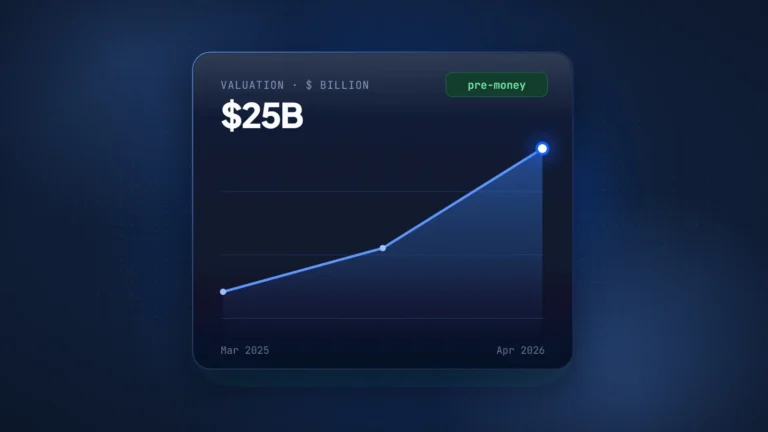
| Reflection AI | March 2024 | Misha Laskin, CEO | “Frontier open intelligence” since October 2025 | Not as of October 4, 2026 | $2 billion at $8 billion (October 2025); a round at $25 billion pre-money closed in April 2026, per its CEO |
There is also a people link to Meta Superintelligence Labs. Tulloch moved to Meta in October 2025, and TechCrunch counted seven Thinking Machines founding members hired by Meta by April 2026.
Does Thinking Machines Lab pursue superintelligence?
Thinking Machines Lab does not say it is building superintelligence or AGI. Its homepage, its Inkling announcement and its July 10, 2026 essay, “The Future Worth Building Is Human”, do not use those terms.
The essay describes a future shaped by human knowledge and decided by human judgment. “AI should enable each organization to be excellent in its own way, not to erase the differences between them,” the essay says of business use.
That sets the lab apart from peers that name the goal outright. SSI calls a safe superintelligence its one goal, and Reflection AI said in March 2025 that it was building superintelligent autonomous systems before it repositioned around open models. Silence is not a denial: the lab has simply not framed its work in those terms on the pages we reviewed. For the concept itself, see our explainer on what superintelligence is.
Can you invest in Thinking Machines Lab?
No. Thinking Machines Lab is a private company with no stock listing, so its shares cannot be bought on a public market or through an ordinary brokerage account.
Its backers are venture firms and strategic investors, including Andreessen Horowitz, Accel and Nvidia. Private-company shares sometimes change hands in secondary deals, but access is usually limited to accredited investors. A reported valuation, such as the $40 billion figure in the 2026 talks, is not a price an individual can trade at. This article is not investment advice.
What to watch next
Three questions remain open for Thinking Machines Lab as of October 5, 2026.
- Funding: whether the round reported in September 2026 closes, and at what size and valuation.
- Models: whether Inkling keeps its Artificial Analysis lead among US open-weights models as other labs release theirs.
- Compute: the Nvidia Vera Rubin deployment, scheduled to start in early 2027.
For developers, Tinker and the Inkling weights are the parts you can test today, so judge the lab by those. For investors and job seekers, the dated record above is a steadier guide than headline valuations. The lab runs its site on thinkingmachines.ai, a common choice for AI companies, and our guide to the .ai domain explains how that extension works.
Brands built around superintelligence have a second option. .si is Slovenia’s country-code domain. For AI companies it reads as SuperIntelligence. Our guide to superintelligence domains compares how AI labs name themselves.