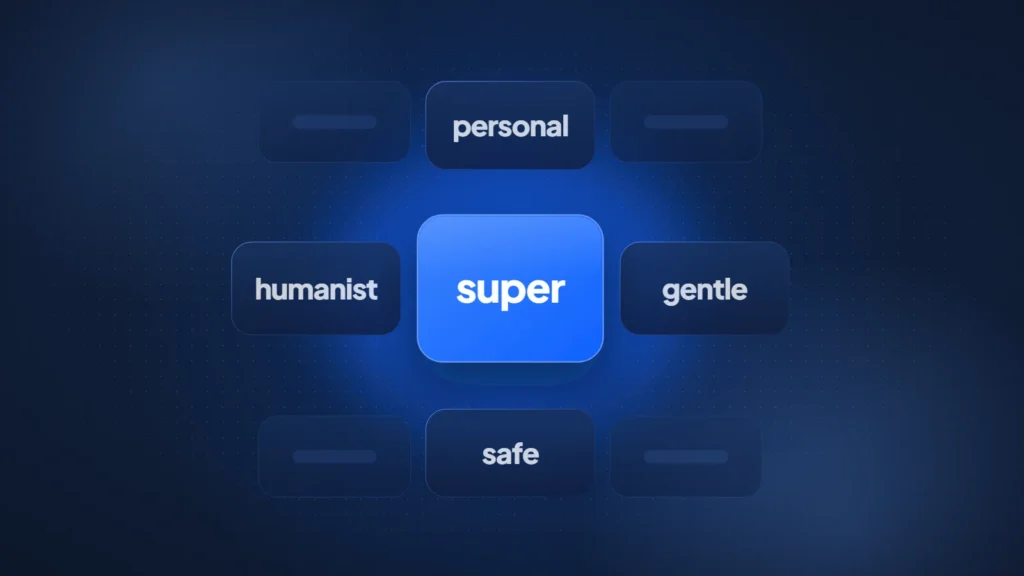
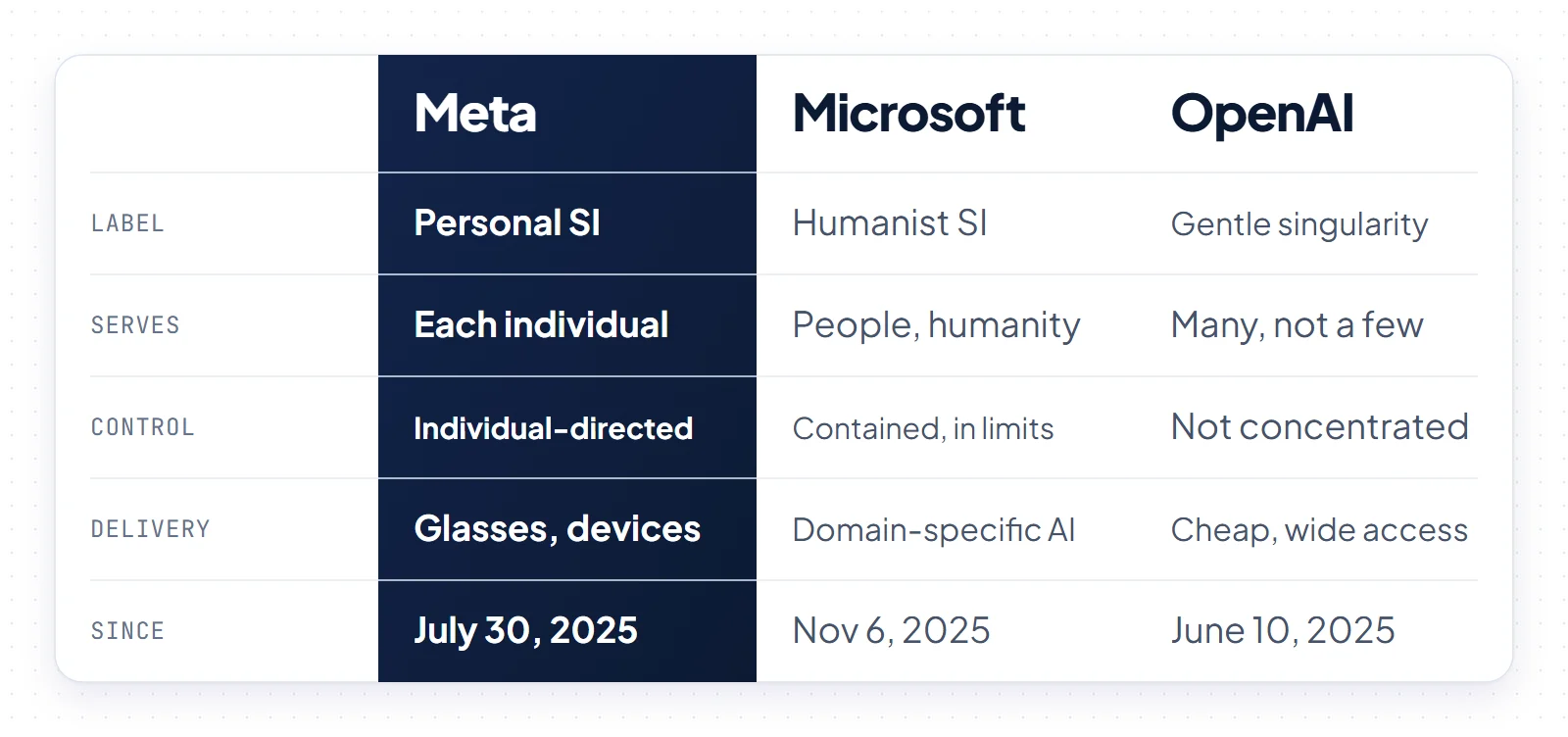
Personal superintelligence is Meta’s label for AI that helps each person pursue their own goals. Microsoft AI uses “humanist”, Safe Superintelligence Inc. uses “safe”, and OpenAI’s Sam Altman calls the transition a “gentle” singularity. Each adjective signals who controls the system and whom it serves. Since late September 2026, “SI” has also started to appear as a brand word.
Search demand has not caught up with the qualifiers. Ahrefs data from October 5, 2026 shows about 20 US and 40 global monthly searches for “personal superintelligence” and 10 US and 20 global for “humanist superintelligence”. The base term “superintelligence” draws 3,800 US and 11,000 global searches. People still search for the base word, which our guide to what superintelligence is explains.
Personal superintelligence and other labels at a glance
Six labs describe the same broad ambition in seven ways. Most add a qualifier that says whom the system serves or who controls it. Anthropic uses a different term, and Google DeepMind has no product label.
| Lab | Label | Exact short phrase | Date | Who controls it / delivery | Source |
|---|---|---|---|---|---|
| Meta | Personal superintelligence | “bring personal superintelligence to everyone” | July 30, 2025 | Individuals, via devices such as glasses | Zuckerberg letter |
| Microsoft AI | Humanist superintelligence | “carefully calibrated, contextualized, within limits” | November 6, 2025 | Domain-specific, under human control | Suleyman post |
| Microsoft AI | Medical superintelligence | “the arrival of medical superintelligence in the next few years” | November 6, 2025 | Domain-specific: diagnostics | Suleyman post |
| OpenAI | Gentle singularity | “Humanity is close to building digital superintelligence” | June 10, 2025 | Cheap, widely available, not too concentrated | Altman blog |
| Anthropic | Powerful AI | “country of geniuses in a datacenter” | October 2024 | Capability-based; avoids “AGI” | Amodei essay |
| Safe Superintelligence Inc. | Safe superintelligence | “one goal and one product: a safe superintelligence” | June 2024 | One product; safety kept ahead | ssi.inc |
| Google DeepMind | Singularity (no product label) | “We’re at the foothills of the singularity” | May 19, 2026 | Mission: “build AI responsibly to benefit humanity” | Semafor |
Meta’s personal superintelligence
Meta’s personal superintelligence is an AI assistant for each individual, delivered through personal devices and set against AI that centrally automates work. Mark Zuckerberg introduced it in a July 30, 2025 letter.
“Meta’s vision is to bring personal superintelligence to everyone,” Zuckerberg wrote in the Personal Superintelligence letter. He describes everyone “having a personal superintelligence that helps you achieve your goals”, delivered through “personal devices like glasses” that can “see what we see, hear what we hear”. He expects them to become people’s main computers.
Zuckerberg defines the label by contrast. Others in the industry, he says, believe superintelligence “should be directed centrally towards automating all valuable work”, while Meta’s version is individual. He calls the rest of this decade “likely to be the decisive period” and adds a caveat about being “careful about what we choose to open source”.
The label sits on a large budget. Zuckerberg’s June 30, 2025 memo created Meta Superintelligence Labs, led by Chief AI Officer Alexandr Wang. Our Meta Superintelligence Labs profile covers the team. Meta’s Q2 2026 results, released July 29, 2026, guided 2026 capital expenditures to $130–145 billion. Yet the earnings release does not use the word “superintelligence”. The label appears in Meta’s letters and essays, not in its headline financial results.
Meta returned to the theme on August 10, 2026, in the essay “The Future is for Everyone: The Path to a Positive AI Future”. By PPC Land’s count, the 6,542-word essay uses “personal superintelligence” 12 times, “balance of power” 23 times and “advertising” zero times.
Microsoft’s humanist and medical superintelligence
Microsoft AI’s humanist superintelligence is defined by limits: domain-specific systems that stay contained and under human control. Mustafa Suleyman set it out on November 6, 2025, when he announced the MAI Superintelligence Team he leads within Microsoft AI.
In Towards Humanist Superintelligence, Suleyman sets the target as capabilities that “always work for, in service of, people and humanity more generally”. The goal is “not an unbounded and unlimited entity with high degrees of autonomy” but AI that is “carefully calibrated, contextualized, within limits” in each domain. He adds that they must be contained and aligned “not just once, but constantly, in perpetuity”.
Suleyman’s post also named a second label, medical superintelligence. “We will see the arrival of medical superintelligence in the next few years,” he wrote. The claim builds on MAI-DxO, which Microsoft described in The Path to Medical Superintelligence on June 30, 2025. Paired with OpenAI’s o3, MAI-DxO correctly solved 85.5% of 304 New England Journal of Medicine cases, while 21 practicing physicians reached a mean accuracy of 20%.
That number comes with caveats. Microsoft says MAI-DxO is “not yet approved for clinical use”, and Microsoft built the benchmark (SD Bench) itself rather than running a clinical trial. The Stack reported that physicians in the test could not use search engines or refer to specialists.
In 2026, Microsoft turned the label into draft rules. On September 14, 2026, it published a draft Humanist AI Code of Conduct for its MAI models and opened a six-week public comment period. It says the models must “never resist human interruption, correction, or shutdown”. They must also not “hide their reasoning from the people auditing them”. Two days later, Suleyman published the essay “A warning about ‘model welfare'” on his personal site. It argued that “AIs are not conscious” and criticized Anthropic’s constitution for Claude.
OpenAI, Anthropic, SSI and Google DeepMind
The other leading labs use softer qualifiers, a different term or none at all.
OpenAI: the gentle singularity
Sam Altman’s essay The Gentle Singularity (June 10, 2025) opens with “We are past the event horizon; the takeoff has started” and says humanity is close to building digital superintelligence. The word “gentle” appears only in the title. Altman wants superintelligence to be “cheap, widely available, and not too concentrated with any person, company, or country”, a stance close to Meta’s. In a November 6, 2025 post, OpenAI argued that no one should deploy superintelligent systems without the ability to align and control them.
Anthropic: powerful AI
Anthropic’s Dario Amodei declines the big labels. In Machines of Loving Grace (October 2024), he writes “I dislike the term AGI” and calls it imprecise and full of sci-fi baggage. He prefers “powerful AI”, a term based on capability that he sums up as “a country of geniuses in a datacenter”.
SSI: safe superintelligence
Safe Superintelligence Inc. puts the qualifier into its company name. Its website describes “the world’s first straight-shot SSI lab, with one goal and one product: a safe superintelligence” and says safety “always remains ahead” of capabilities. Our Safe Superintelligence profile covers the company.
Google DeepMind: the foothills of the singularity
Google DeepMind has no branded superintelligence label, and its mission, “build AI responsibly to benefit humanity”, avoids the word. Closing the Google I/O keynote on May 19, 2026, Demis Hassabis said “We’re at the foothills of the singularity”, according to Semafor. In his reading, the singularity “means the era that we’re in”.
What the labels share and where they differ
All the labels pair a promise of great capability with a reassurance. They differ on control, timing and revenue. The qualifier signals a control stance and an audience, not a measured capability.
| Lab | Control stance | Timeline signal | Safety framing | Commercial link |
|---|---|---|---|---|
| Meta | Individuals, not central automation | This decade “decisive” | Care over open source | Glasses; $130–145B 2026 capex |
| Microsoft AI | Contained, human override | Medical SI “in the next few years” | No resisting shutdown | Domains such as diagnostics |
| OpenAI | “Not too concentrated” | “Past the event horizon” | Align and control first | “Cheap, widely available” |
| SSI | One lab, one product | Not stated on its website | Safety “always remains ahead” | One goal, one product |
Control is the clearest dividing line among the labs’ superintelligence labels. Meta and OpenAI frame control as distribution: superintelligence should reach many people, not sit with one company. Microsoft frames it as containment, where humans can always interrupt, correct or shut a system down. SSI frames it as sequencing, with safety kept ahead of capability.
Meta’s and Microsoft’s timelines stay vague. Meta’s “decisive period” and Microsoft’s “next few years” signal urgency without a date. Altman is more specific about interim steps: he expects systems that can figure out novel insights in 2026. Still, none of the quoted definitions says how to tell when superintelligence has arrived.
Revenue gets the least attention. Meta’s label maps onto devices and a 2026 capital budget of up to $145 billion, Microsoft’s onto domains such as medicine, and OpenAI’s onto cheap, broad access. Altman is the most direct, writing that “before anything else, we are a superintelligence research company” in the same essay.
What critics say about the labels
Critics mostly read the qualifiers as marketing until evidence arrives. Most published critiques target Meta and Microsoft.
- On Meta: “This supposed distinction is marketing, not substance,” Marcus Schuler wrote in Implicator.ai on July 30, 2025.
- On Microsoft: in Fortune on November 6, 2025, Sharon Goldman and Jeremy Kahn wrote that “for now, it’s better marketing than science”, and Paul Roetzer of SmarterX warned on November 11 that “eventually this clashes with what Microsoft has to do to justify their investment in AI”.
- On OpenAI: a day after Altman’s essay, Nieman Lab’s Joshua Benton asked in a June 11, 2025 headline “when did the singularity become ‘gentle’?”
- On Meta’s 2026 essay: TechCrunch’s Russell Brandom wrote that Zuckerberg’s manifesto is “exactly why people don’t like AI”, a view TechCrunch’s Equity podcast discussed on August 16, 2026.
Lessons for naming and positioning SI products
For founders who put “superintelligence” or “SI” in a product name, the labels suggest an approach: name the purpose, prove the capability separately and use words people search for.
- Separate the label from the capability. “Personal”, “humanist” and “safe” describe intent and control, not performance. Microsoft paired its medical label with a benchmark number and a caveat, and that pairing is worth copying.
- Avoid overclaiming. Microsoft’s own wording, “not yet approved for clinical use”, shows how to state a limit next to a bold claim. A product page that calls itself superintelligent without evidence invites the critiques above.
- Be careful with trademarks. Descriptive words such as “superintelligence” or “SI” can be hard to protect as marks for AI software, and labs already use “superintelligence” in unit names. Check existing filings and consult a trademark attorney before you commit.
- Write in plain English. Amodei’s “country of geniuses in a datacenter” explains more than an acronym. Search data agree: the base word draws the searches, so let the qualifier explain your stance.
.si and SI as a brand word
In late September 2026, “SI” started to appear as a brand word, and .si domains are part of that story. US federal policy drove the shift, although most leading labs still say “AI”.
Executive Order 14434, signed September 29, 2026, made “SI” the US federal term and told the executive branch to use it instead of “AI”. Our explainer on what SI stands for covers the order. Labs used the word in unit names earlier: SSI (June 2024), Meta Superintelligence Labs (June 2025) and the MAI Superintelligence Team (November 2025).
The clearest corporate move since the order involves SpaceXAI, the AI unit of Elon Musk’s SpaceX. According to Fox Business (October 4, 2026), Musk replied on X with “Yes, we will make that change” and “No more AI. SI, it’s better”, indicating that SpaceXAI would become SpaceXSI. The Next Web (October 5, 2026) reported the same reply and noted that Musk gave no date, so the rename remains a stated intent.
.si is Slovenia’s country-code domain. For AI companies it reads as SuperIntelligence. That reading is our framing, not an official meaning, and the executive order has nothing to do with the .si domain.
A .si domain has two limits. Google Search Central lists the country-code domains it treats as generic, such as .ai and .io. The .si domain is not on that list, so Google treats a .si site as a Slovenia signal. A domain also adds no capability: a .si address can carry an SI position, but it cannot prove one.
Founders use .si for SI positioning as a campaign or product site, a short redirect to a main .com or .ai site, or a defensive registration. Our overview of superintelligence domains covers these patterns. Disclosure: buysidomains.si sells .si names, so weigh our view with that in mind.