Demis Hassabis is the British AI researcher who co-founded DeepMind in 2010 and shared the 2024 Nobel Prize in Chemistry for protein structure prediction with AlphaFold. Since August 5, 2026, he has been Chair of Google DeepMind and Chief Scientist of Alphabet, and he still leads Isomorphic Labs. Koray Kavukcuoglu now runs Google DeepMind day to day as SVP.
The change matters because many profiles, and the 2024 Nobel announcement, still describe him as CEO of Google DeepMind. That title was accurate until August 2026. This profile traces his career through dated primary sources, quotes what he has said about AGI, and reports a Google Scholar check that BuySI Domains ran on October 22, 2026.
Who is Demis Hassabis? Chess, games and neuroscience
Before DeepMind, Demis Hassabis was a chess prodigy, a game programmer and a neuroscientist. He was born in London in 1976, according to NobelPrize.org. The Royal Society describes him as “a child chess prodigy” who “coded the classic game Theme Park aged 17.” The Academy of Achievement says he was a recognized chess master by 13 and joined Bullfrog Productions as a teenager.
After Bullfrog he studied computer science at the University of Cambridge and graduated in 1997 with top honors. He then joined Lionhead Studios as lead programmer on Black & White. In 1998 he founded Elixir Studios, which made games for Microsoft and Vivendi. In 2005 he sold the rights to its games and wound the studio down.
Science came next. Hassabis completed a PhD in cognitive neuroscience at University College London in 2009. The Royal Society notes that the journal Science listed his research on imagination and memory among the top 10 breakthroughs of 2007. His first-author study showed that patients with hippocampal amnesia cannot imagine new experiences, tying memory to imagination.
Demis Hassabis and DeepMind: from founding to Google DeepMind
DeepMind Technologies was incorporated in London on September 23, 2010, according to UK Companies House. Hassabis co-founded it with Shane Legg and Mustafa Suleyman, and the lab aimed at general AI from the start. He later wrote that in 2010 “many people thought general AI was a farfetched science fiction technology.”
Google acquired DeepMind in January 2014; the price was never officially disclosed. In February 2015 the team published “Human-level control through deep reinforcement learning” in Nature, the paper behind the DQN agent. A year later AlphaGo made the lab famous. In March 2016 it beat Go champion Lee Sedol 4–1 in Seoul, a match DeepMind says more than 200 million people watched.
On April 20, 2023, Alphabet merged DeepMind with the Brain team from Google Research into a single unit, Google DeepMind. Sundar Pichai’s announcement of Google DeepMind named Hassabis its CEO, responsible for “our most capable and responsible general AI systems.” He held that role for a little over three years.
Demis Hassabis and the 2024 Nobel Prize: AlphaFold and Isomorphic Labs
Demis Hassabis shared the 2024 Nobel Prize in Chemistry with John Jumper “for protein structure prediction,” while the other half went to David Baker “for computational protein design.” The prize was announced on October 9, 2024. The Nobel press release says AlphaFold2 helped predict the structure of virtually all 200 million known proteins and has been used by more than two million people from 190 countries.
AlphaFold got there in stages. In November 2020 the organizers of CASP, the biennial protein structure assessment, recognized AlphaFold as a solution to a 50-year-old challenge in biology, DeepMind reported. On July 28, 2022, DeepMind expanded the AlphaFold Protein Structure Database from nearly 1 million structures to over 200 million.
Hassabis also turned the work into a company. In November 2021 he announced Isomorphic Labs, a new Alphabet company set up to “reimagine the entire drug discovery process from first principles with an AI-first approach.” On May 8, 2024, Google DeepMind and Isomorphic Labs introduced AlphaFold 3, which predicts the structure and interactions of proteins, DNA, RNA, ligands and more. Isomorphic says it raised $600 million in March 2025 and $2.1 billion in May 2026, both rounds led by Thrive Capital.
Honors followed the science. Hassabis was appointed CBE in the 2018 New Year Honours and became a Fellow of the Royal Society in 2018. The London Gazette records his knighthood “for services to Artificial Intelligence,” dated March 28, 2024. He gave his Nobel lecture, “Accelerating scientific discovery with AI,” in Stockholm on December 8, 2024.
What Demis Hassabis does now
Demis Hassabis is Chair of Google DeepMind and Chief Scientist of Alphabet, roles he took on August 5, 2026, and he continues to lead Isomorphic Labs. As Sundar Pichai put it in Google’s announcement of the change, “Demis will become the Chair of GDM and Chief Scientist of Alphabet, while continuing to lead Isomorphic Labs.” In his own note, Hassabis said he would hand over his “day-to-day operational responsibilities” at Google DeepMind.
Koray Kavukcuoglu, until then its chief technology officer, became SVP of Google DeepMind. Some outlets have called Kavukcuoglu CEO, but Google gives his title as SVP.
The timeline below collects the main dated steps, each with the source we relied on.
| Date | Event | Source |
|---|---|---|
| 1976 | Born in London | NobelPrize.org |
| 1997 | Graduates in computer science, University of Cambridge | Academy of Achievement |
| 1998 | Founds Elixir Studios | Academy of Achievement |
| 2009 | PhD in cognitive neuroscience, UCL | NobelPrize.org |
| September 23, 2010 | DeepMind Technologies incorporated | UK Companies House |
| January 2014 | Google acquires DeepMind | The Guardian |
| March 2016 | AlphaGo beats Lee Sedol 4–1 in Seoul | Google DeepMind |
| November 2020 | AlphaFold recognized at CASP14 | Google DeepMind |
| November 2021 | Announces Isomorphic Labs | Isomorphic Labs |
| July 28, 2022 | AlphaFold database passes 200 million structures | Google DeepMind |
| April 20, 2023 | Google DeepMind formed, Hassabis as CEO | |
| March 28, 2024 | Knighthood for services to AI | The London Gazette |
| May 8, 2024 | AlphaFold 3 introduced with Isomorphic Labs | |
| October 9, 2024 | Nobel Prize in Chemistry, shared | NobelPrize.org |
| August 5, 2026 | Chair of Google DeepMind, Chief Scientist of Alphabet |
What Demis Hassabis has said about AGI
Demis Hassabis’s dated statements place AGI steadily closer: a five-to-10-year horizon in March 2025, then “close at hand” in August 2026. At a March 2025 briefing in DeepMind’s London offices, he said that “over the next five to 10 years, a lot of those capabilities will start coming to the fore,” CNBC reported. In his note to staff on August 5, 2026, he wrote: “I’ve been working towards AGI my whole life and now, like many of you, I feel it is close at hand.”
His working definition is broad. At the same briefing he defined AGI as “a system that’s able to exhibit all the complicated capabilities that humans can.” That sets a human benchmark, which is the line our guide to how AGI differs from ASI draws between general and superhuman systems.
In the August post, Pichai added that “Demis has described us as standing in the foothills of the singularity.” That phrase is Pichai’s summary of Hassabis’s view, not a direct quote from Hassabis in the post. Reports of later 2026 interviews give other timelines, so this profile keeps to the dated primary quotes. Forecasts from other lab leaders sit in our AGI timeline tracker.
Hassabis pairs that outlook with warnings. In October 2023 he told the Guardian that “we must take the risks of AI as seriously as other major global challenges, like climate change.” He also suggested an IPCC-like body as a starting point for oversight. On October 14, 2026, Reuters reported that he called recent hacking incidents involving AI agents “early warning shots.”
Demis Hassabis on Google Scholar: what the citations show
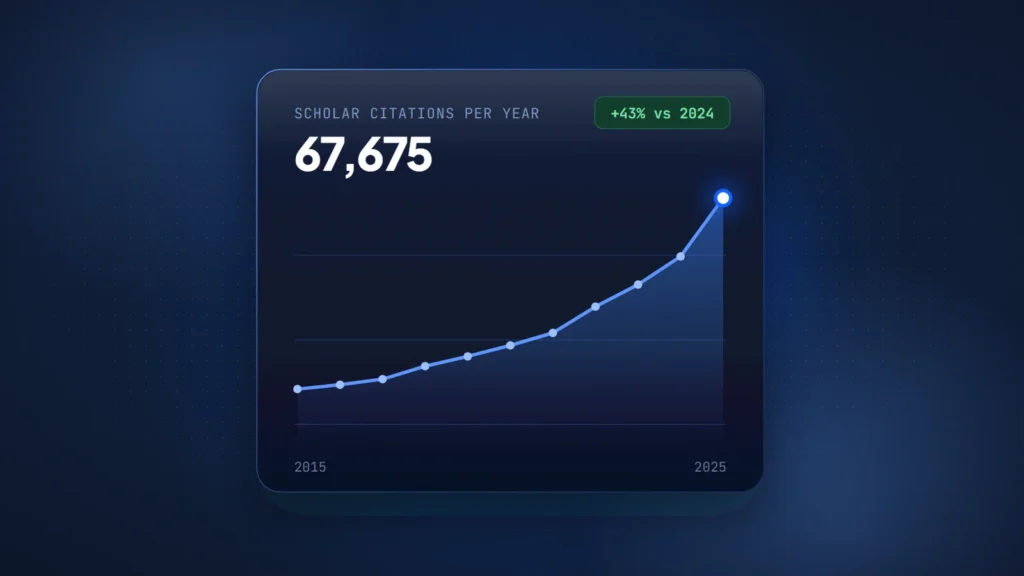
The Google Scholar profile of Demis Hassabis showed 322,551 citations and an h-index of 110 on October 22, 2026, according to a check by BuySI Domains. About 84% of those citations, 271,635, arrived from 2021 onward. Yearly citations grew from 12,379 in 2019 to 67,675 in 2025, and the 2026 count had already reached 67,917 by October 22.
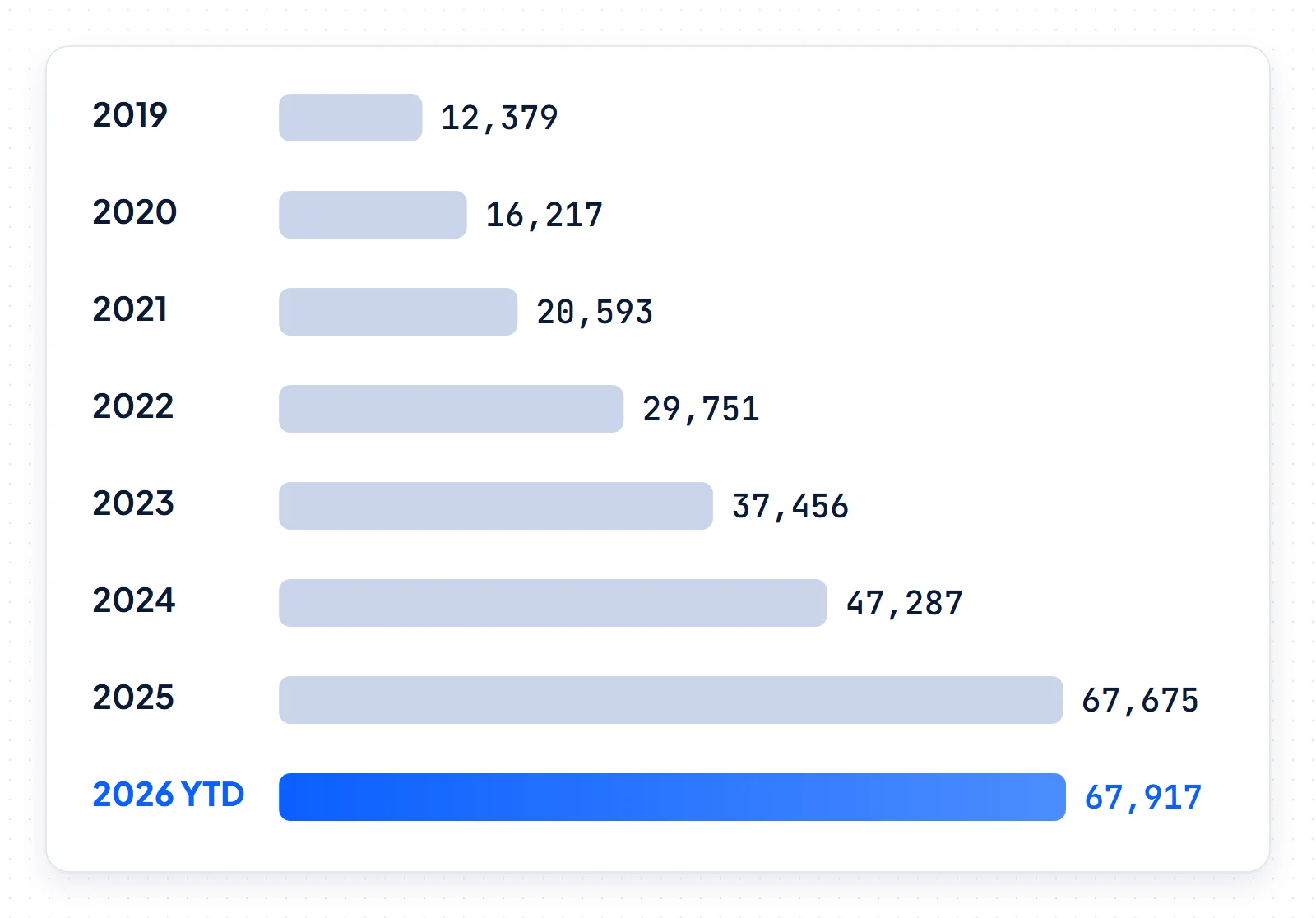
Three papers lead the public Scholar profile, and each marks a stage of DeepMind’s work.
| Paper | Year | Journal | Citations (October 22, 2026) |
|---|---|---|---|
| Highly accurate protein structure prediction with AlphaFold | 2021 | Nature | 56,856 |
| Human-level control through deep reinforcement learning (DQN) | 2015 | Nature | 45,163 |
| Mastering the game of Go with deep neural networks and tree search (AlphaGo) | 2016 | Nature | 26,356 |
Read these numbers with care. The profile is unverified, showing “No verified email,” and Scholar profiles can add papers automatically. The top entries are large team papers with many co-authors, so the totals reflect DeepMind’s collective output as much as his own. Other citation databases count differently, and Scholar figures change daily.
DeepMind, AGI and the word superintelligence
Google DeepMind’s public mission language centers on AGI. Its About page says AI, “and ultimately artificial general intelligence (AGI),” could drive “one of the greatest transformations in history.” The word superintelligence enters through the lab’s research vocabulary and through a book about Hassabis.
Google DeepMind’s “Levels of AGI” paper, first posted on arXiv on November 4, 2023, defines Level 5, “Superhuman,” as a system that outperforms 100% of humans. In its general-AI column, Level 5 is “Artificial Superintelligence (ASI),” marked “not yet achieved.” The same matrix places AlphaFold at Level 5 as superhuman narrow AI. The authors include co-founder Shane Legg; Hassabis is not one of them.
That matrix uses the narrow-versus-general split found in most overviews of the main types of AI, and its top level matches the usual definition of artificial superintelligence (ASI). It ranks what systems can do. How a system might climb from AGI to ASI, for example through recursive self-improvement, is a separate debate.
The word also reached his biography. Sebastian Mallaby’s The Infinity Machine: Demis Hassabis, DeepMind, and the Quest for Superintelligence was published by Penguin Press on March 31, 2026. The subtitle is the author’s and publisher’s framing, not a Google DeepMind term.
Washington changed its own vocabulary in 2026. Executive Order 14434, signed on September 29, 2026, tells the executive branch to use “Super Intelligence” and “SI” in place of “Artificial Intelligence” and “AI.” The order names no company. As of October 22, 2026, BuySI Domains found no statement about it from Google DeepMind or Hassabis.
.si is Slovenia’s country-code domain. For AI companies it reads as SuperIntelligence. That reading is our framing, not an official one. Google DeepMind made its own extension choice. As of October 22, 2026, deepmind.com redirects with an HTTP 302 to deepmind.google. RDAP shows that name was registered on September 7, 2023 (checked by BuySI Domains on October 22, 2026).
For founders naming a research-led AI company, DeepMind shows that a short lab name can outlast any single product. essai.si follows that pattern: essai is French for an attempt or trial, a fitting word for a lab. BuySI Domains lists essai.si for sale.
For readers following Hassabis, the practical rule is to date everything. Check his title against August 5, 2026, read each AGI timeline against its original source, and treat paraphrases and secondhand reports as exactly that.