How to name a business, in short: write a one-page brief, brainstorm widely, cut to five names and test them on real customers. Then clear your favorite with the state registry, the trademark office and the domain market before you register anything. Each step ends with one deliverable, and the domain comes last.
A careful process matters more in late 2026 than it used to, because names now date faster. Executive Order 14434, signed on September 29, 2026, told federal agencies to say “SI” instead of “AI,” and within two weeks a Salesforce product had its third name in about six months. When BuySI Domains checked the Forbes AI 50 on October 22, 2026, three companies on the list had already moved to a new .com.
How to name a business in seven steps
To name a business, run seven steps in order. Write a one-page naming brief, brainstorm 50 to 100 candidates, then cut them to a shortlist of five and test recall. Next, check the legal name with your state registry, search the trademark register, secure the domain and social handles, and decide and register everything on the same day.
The sequence is deliberate. Creative work comes first because legal checks are quick on five names and slow on fifty. Legal checks come before the domain, because a name that fails a trademark search turns any domain purchase into wasted money. The domain comes last because it is the one layer you can lock in minutes.
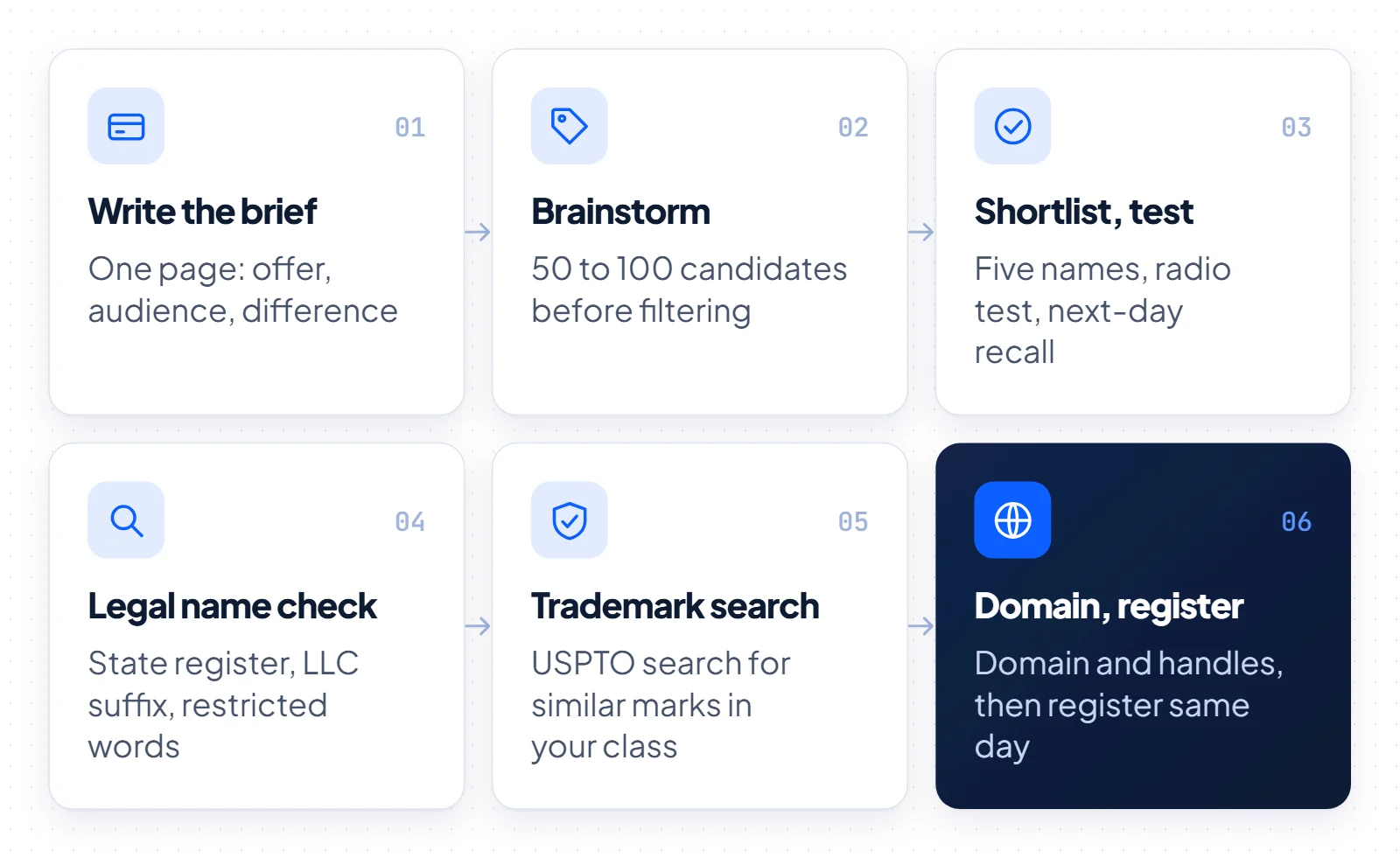
The diagram groups steps 6 and 7, which founders usually finish in one sitting.
Steps 1 to 3: brief, brainstorm, shortlist
Step 1: write a one-page naming brief
The deliverable is a single page with four lines: what you sell, who buys it, how you differ from your closest competitors, and what the name must still fit in five years. Add hard constraints, such as the languages and markets where the name must work. The brief settles arguments later, because every candidate is judged against it rather than against taste.
Step 2: brainstorm without filtering
Naming a company starts with volume: the deliverable is a long list of 50 to 100 candidates. Generate them from the brief: benefit words, metaphors, coined words and combinations. Our domain name ideas guide lists naming patterns to borrow. Filtering early kills the odd ideas that often become the best names. If you build in AI, our look at how leading AI companies chose their names shows which approaches are already crowded.
Step 3: cut to five and test recall
The deliverable is a shortlist of five names with test notes. Strike anything that breaks the brief, is hard to spell after one hearing, or sounds like a competitor. Then test the five on people from your target market.
Three tests cover most failures. In the radio test, you say the name once and the listener writes it down. In the recall test, you ask the next day which name they remember. In the translation check, you look up slang and meanings in every language on your brief. A Rivier University blog post cites Kaggle, which some listeners hear as “Kegel,” and quotes a founder’s advice to pick the name people remember most, not the one they like best.
There is evidence behind the radio test. In a 2006 PNAS study reported by Nature News, psychologists Adam Alter and Daniel Oppenheimer found that stocks with easy-to-pronounce names outperformed hard-to-pronounce ones shortly after they began trading. The effect faded within months, and Oppenheimer cautioned investors against acting on it. The fair reading: an easy name helps first impressions, not long-term results.
The four layers of a business name
A business name is registered in four separate places. The U.S. Small Business Administration lists them as the entity name filed with your state, a DBA, a federal trademark and a domain name. Owning one gives you none of the others: an approved LLC name is not a trademark, and the SBA notes that a DBA “doesn’t provide legal protection by itself.”
| Layer | Where it is registered | What it gives you | Rule to know |
|---|---|---|---|
| Legal entity name | State filing office, usually the Secretary of State | State-level protection of the name | Needs a designator such as “LLC”; must be distinguishable |
| DBA (trade or fictitious name) | State, county or city, depending on location | Right to trade under another name; no protection by itself | Most states require one if you use it |
| Trademark | USPTO (federal); rights also arise from use | Nationwide rights once federally registered | Base fee $350 per class since January 18, 2025 |
| Domain name | An accredited registrar | Exclusive use while you keep renewing | Need not match the legal name |
The layers do not have to match. According to the SBA’s guide to choosing a business name, your domain “doesn’t actually need to be the same as your legal business name,” and the same holds for your brand. That flexibility is the main defense against a name that dates.
Steps 4 and 5: legal name and trademark checks
Step 4: check the legal name with your state
The deliverable is a clearance sheet: each finalist searched in the register of the state where you will form the company, with the exact legal form and suffix. Naming rules come from each state, so read your Secretary of State’s guidance. The examples below are typical, not universal.
An LLC’s legal name must include a designator. Delaware’s LLC Act, 6 Del. C. § 18-102, requires “Limited Liability Company,” “L.L.C.” or “LLC” and a name distinguishable from others on the state’s records. It also bars the word “bank” except for regulated banks or clearly non-banking uses. California Corporations Code § 17701.08 sets the same designators and also accepts “Ltd.” and “Co.” as abbreviations.
State approval is narrower than it looks. The California Secretary of State compares a proposed LLC name only with other LLC names and does not check trademarks or fictitious business names. You can reserve a name there for 60 days. An accepted filing means nobody in that register has the name, not that the name is safe from a trademark claim.
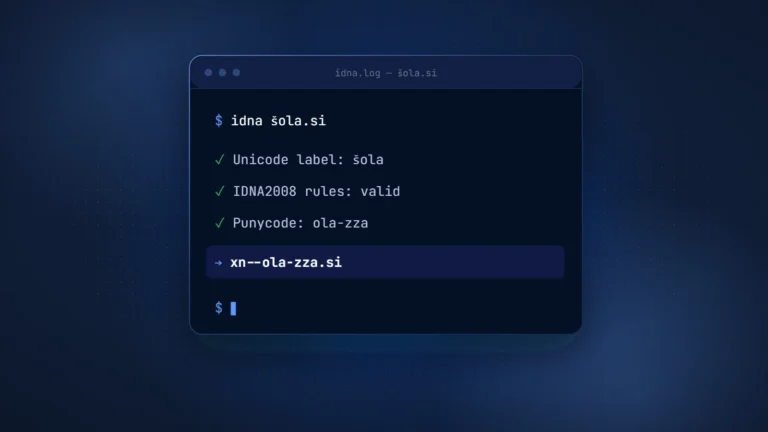
Outside the U.S. the pattern is similar. UK Companies House requires a private limited company’s name to end with “limited” or “Ltd” and treats two names as the same if they are likely to confuse the public. In Slovenia, a limited liability company’s name carries the d.o.o. designation and must differ from names already in the business register, which AJPES maintains and into which registry courts enter companies.
Step 5: search the trademark register
The deliverable is a search log for each finalist in the USPTO’s free Trademark Search system, which replaced the older TESS database on November 30, 2023. Search exact spellings, phonetic variants and translations, then narrow the results to the classes of goods and services you sell.
The USPTO calls likelihood of confusion the most common reason for refusing registration. Marks do not have to be identical to conflict: they can be similar in sound, appearance or meaning, and the goods only have to be related. A finalist one letter away from a live mark in your class is a weak candidate.
Federal trademark registration is optional, but it decides how far your rights reach. According to the USPTO, rights in a business name begin when you use it, but only in your geographic area, while federal registration creates nationwide rights. U.S. courts have ranked marks on a distinctiveness scale since the 1976 Abercrombie & Fitch decision. Coined and arbitrary words are generally the easiest to defend, while descriptive names stay weak until they acquire distinctiveness. Our guide to trademarking an AI company name covers the sector’s pitfalls.
Steps 6 and 7: secure the domain, then decide
The deliverable for step 6 is a grid: for each finalist, the domain you would use, whether it is free or for sale, and the matching social handles. Start it at shortlist stage, because the domain often breaks a tie between two equal names, but buy nothing until the name has passed steps 4 and 5. Our checklist for choosing a domain name covers length, extension and spelling.
The domain does not have to be the exact brand on .com. Many well-funded companies run on another extension or a short variant. If the domain you want belongs to someone else, buying a brandable domain can be faster than another round of brainstorming.
Step 7’s deliverable is a dated decision note and a same-day registration. Pick the finalist that passed every check, file the entity name, add a DBA if the brand differs, register the domain and claim the handles. Keep the name private until every layer is secured, so nobody can register the domain or file the mark ahead of you.
Our data: the domains behind the Forbes AI 50
Of the 50 companies on the Forbes AI 50 2026 list, published April 16, 2026, 24 run their main website on .com, 19 on .ai and 7 on other extensions. BuySI Domains checked every primary domain on October 22, 2026. Two of the seven use .io, and the remaining five each use a different extension: .co, .app, .dev, .website and .inc.
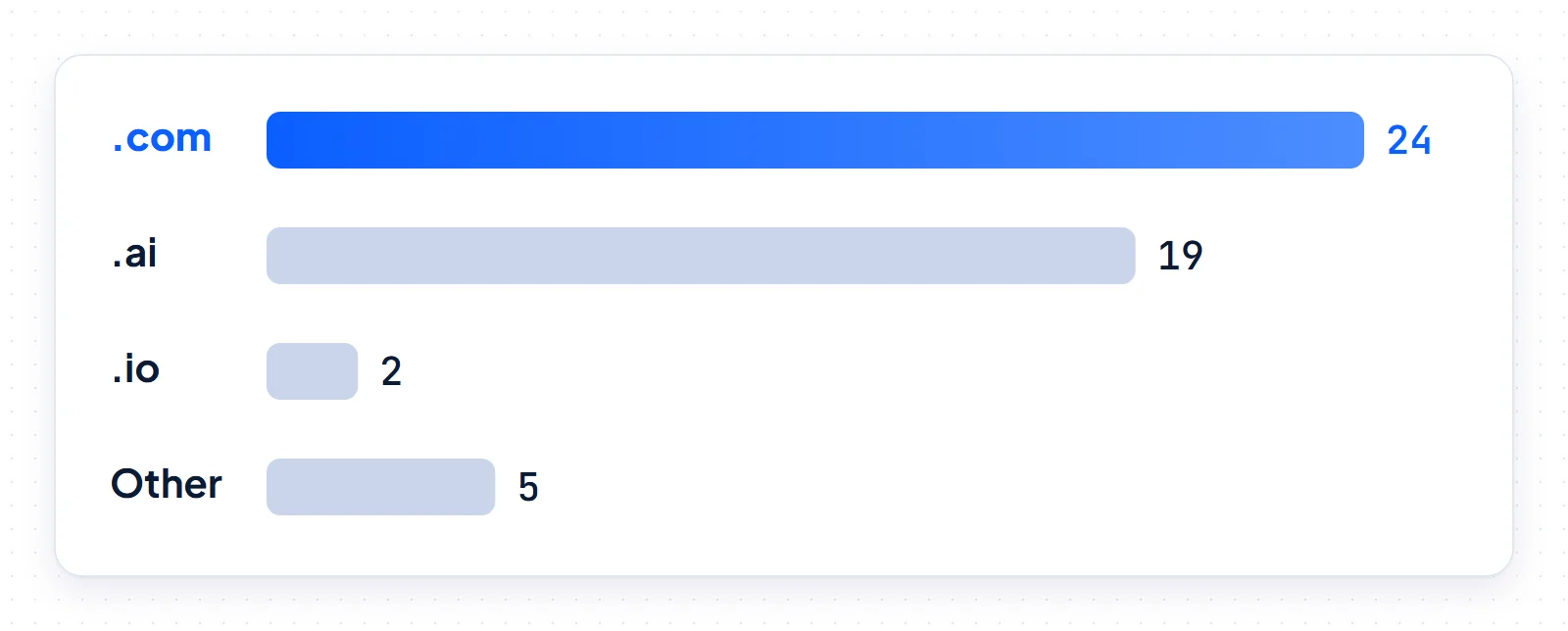
Our method: we took every company on the Forbes AI 50, loaded each main website and recorded the final domain after redirects. We then queried the .si registry’s public RDAP service for each brand word, written as one word without a trailing “AI.”
Three companies have already moved off their first domain. The address cognition.ai now redirects to cognition.com, rogo.ai to rogo.com, and runwayml.com to runway.com, dropping the “ml” descriptor. Naming is not finished at launch.
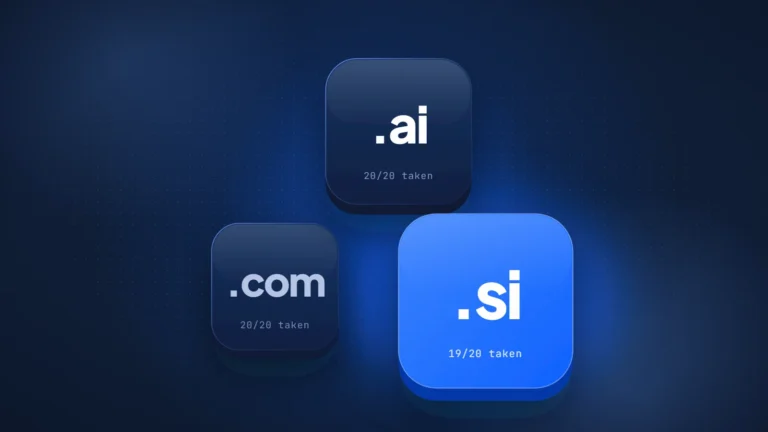
.si is Slovenia’s country-code domain. For AI companies it reads as SuperIntelligence. On October 22, 2026, all 50 brand words were already registered in .si, and none of the 50 companies uses .si as its main domain. Only two of the 50 .si names appeared to be held by the company itself: one redirects to the company’s website and one shows a brand-protection service page.
Most of the rest, 34 of 50, showed a marketplace or parking page, and 6 showed unrelated active sites, typically older Slovenian projects using the same word. Another 7 had no website, and 1 could not be checked. The registry does not publish holders, so this split reflects only what each address displayed that day. Check every extension you might want before you announce a name, not after.
Naming in the SI era
A trend word in a business name can go stale within weeks. Executive Order 14434, signed on September 29, 2026, tells federal agencies to use “Super Intelligence” and “SI” in place of “Artificial Intelligence” and “AI.” The order covers federal materials only, so every private rename since then, including Marc Benioff’s October 9, 2026, post renaming AIForce to SIForce, has been voluntary.
Some executives moved anyway. SalesforceBen reported that SIForce was the agent platform’s third name in about six months, and found no official announcement from Salesforce. Elon Musk said on X on October 4, 2026, that he would rename SpaceXAI to SpaceXSI. As of October 22, 2026, BuySI Domains found no report of a filing or a completed rename.
The lesson for anyone naming a business in 2026 is to keep trend words out of the legal entity name. Put them in a product name, a tagline or the domain, where a change is cheap. Salesforce renamed a product, not the company. Among the Forbes AI 50, eight company names carry “AI.” Five of them, including Mistral AI on mistral.ai, drop it from the brand word and carry it in the .ai extension instead. Forbes lists another, Genspark, under its domain, Genspark.ai.
A country-code domain can carry meaning the same way. Read as SuperIntelligence, which is our framing and not an official meaning, a .si domain puts the category signal in the extension so the brand word can stay neutral. A three-letter name such as mkr.si, shorthand for maker, works like that. BuySI Domains lists mkr.si for sale. Whatever the extension, run the state and trademark checks on the brand word first.
Which step to start with
With no name yet, write the one-page brief before you brainstorm. If you already love a name, run steps 4 and 5 this week: both searches are free and show whether the name is worth defending. If you have an entity but a weak domain, change the domain or trade under a DBA without forming a new company. Rules differ by state and country, so check with your Secretary of State and consult a trademark attorney before you file.